
February 12, 2026
DevSecOps Architecture Explained: Security as Code, Policy Automation, and GitOps

Chintan Viradiya
Author

Nandini Parekh
Contributor

Rakshit Menpara
Reviewer
The DevSecOps conversation is still often framed as a discussion of technical maturity, focusing on tooling gaps, security debt, or process inefficiencies. That framing is outdated and dangerously incomplete.
Security incidents such as Log4j and SolarWinds demonstrated a hard truth: security failures are now existential business risks. They damage customer trust, regulatory standing, market valuation, and executive credibility. At cloud scale, breaches are not isolated technical events; they are systemic failures in how software is built, delivered, and governed.
The root cause is structural. For years, organizations optimized for velocity (Dev) and stability (Ops), while security remained an afterthought enforced through annual audits, ticket-based reviews, and manual sign-offs. That model collapsed under the realities of cloud-native architectures, continuous delivery, and AI-assisted code generation.
DevSecOps emerged not as “security earlier in the lifecycle,” but as a necessary evolution of control - a way to embed security as a continuous, automated, and measurable system across the entire software delivery lifecycle (SDLC).
This blog explains the DevSecOps architecture correctly: as Security as Code, Policy as Code, and GitOps-driven control planes that protect speed rather than restrict it.
The Evolution of DevSecOps: From Bottleneck to Enabler
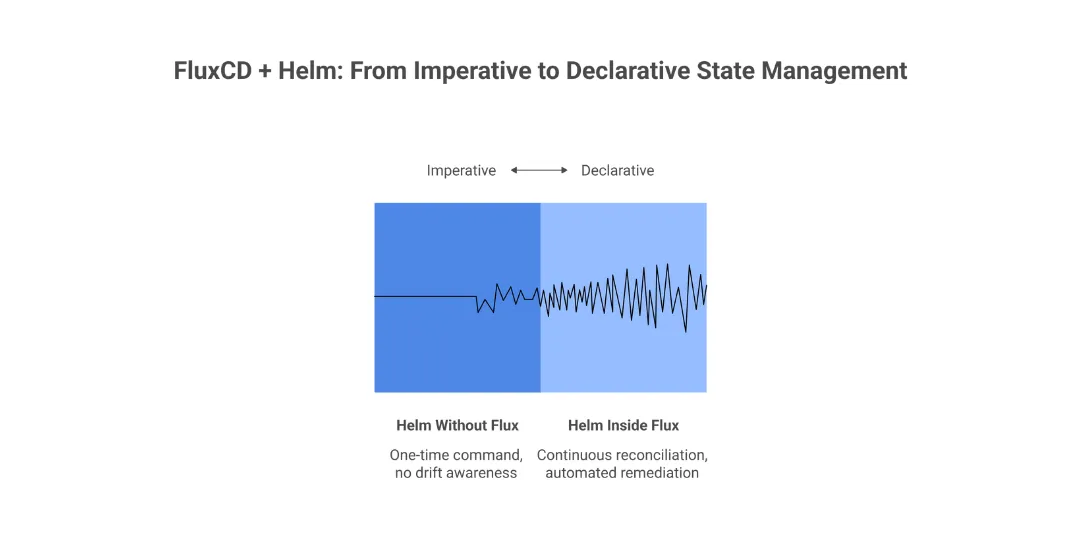
The Speed Gap (Impedance Mismatch):
CI/CD pipelines operate at machine speed, deploying code multiple times per day via event-driven triggers in tools like GitHub Actions or GitLab CI. Traditional security reviews rely on human-speed, ticket-based workflows, creating an impedance mismatch. This friction leads to “security bypassing” to meet release deadlines, particularly in high-velocity microservices architectures.
Also Read: CI with GitHub Actions: End-to-End Pipeline Setup Guide
Manual Gate Latency:
Legacy approval systems (e.g., Jira, ServiceNow) introduce “waiting rooms” that stall deployments. This latency negates the ROI of automation investments and increases the “Mean Time to Remediate” (MTTR), as developers lose context while waiting for manual sign-offs on vulnerabilities that could have been caught automatically.
Static Scans vs. Runtime Observability:
Static Application Security Testing (SAST) and Software Composition Analysis (SCA) capture only a point-in-time snapshot of code and dependencies. In ephemeral Kubernetes environments, infrastructure is immutable, and state changes continuously.
Relying solely on static scans ignores runtime behavior; modern DevSecOps requires continuous observability and eBPF-based runtime protection to detect anomalies in live, auto-scaling containers.
Software Supply Chain & Artifact Integrity:
Security must validate the entire supply chain, not just the source code. This involves generating and verifying Software Bill of Materials (SBOMs), ensuring artifact provenance via cryptographic signing (e.g., Sigstore/Cosign), and scanning Infrastructure-as-Code (IaC) templates (Terraform/Bicep) to prevent misconfigurations before cloud resources are provisioned.
Policy as Code (PaC):
DevSecOps transforms security from a manual phase into Policy as Code. By integrating executable rules directly into the SDLC using engines like Open Policy Agent (OPA) or Kyverno, organizations shift from “Security as a Gate” to “Security as a Guardrail,” enabling automated enforcement that scales at the speed of the pipeline.
DevSecOps Defined Correctly
DevSecOps fundamentally transforms security from documentation into executable logic. This is not semantic wordplay - it’s an architectural shift with profound implications.
Security as Code (Implementation) Security controls are treated as version-controlled software artifacts subject to the same peer review and CI/CD testing as application logic.
- Infrastructure-as-Security: Firewall rules, IAM roles, and mTLS configurations are defined via IaC (Terraform/Pulumi).
- Functional Security: Secrets rotation, certificate renewal, and encryption-at-rest are handled by testable, automated functions rather than manual configuration.
Policy as Code (Governance) Compliance and security requirements are expressed as executable logic that the control plane enforces programmatically.
- Automated Guardrails: Instead of manual checklists, engines like Open Policy Agent (OPA) act as admission controllers, automatically rejecting any deployment that lacks mandatory labels, uses unauthorized base images, or runs as “root.”
- Continuous Compliance: Policies are versioned and immutable, allowing for “Compliance as Code” where the current state of the environment is always auditable against the defined policy.
The Core Principle: The Automation Mandate**.** In a cloud-native ecosystem, a security control that cannot be automated, audited, and enforced by the pipeline is a systemic failure point. Manual processes introduce human error and create architectural bottlenecks. Only automated, executable controls provide the continuous verification necessary to secure software at the speed of modern delivery.
DevSecOps Architecture: How It Works End-to-End
Secure Software Supply Chain (SSSC)
- Source Integrity: Enforce GitHub branch protections and mandatory GPG/SSH commit signing. Achieve SLSA Level 3 by using OIDC-based build attestations to prove provenance.
- Dependency Management: Automatically generate SBOMs (CycloneDX/SPDX) using Syft; ingest into Dependency-Track to monitor transitive CVEs and enforce license compliance (e.g., blocking AGPL).
- Artifact Trust: Use Cosign to sign container images in a private registry (e.g., Harbor). Deploy a Kyverno or OPA admission webhook to verify signatures and attestations before pulling any image.
High-Velocity CI Security
- Intelligent Triage: Combine Grype with EPSS (Exploit Prediction Scoring System) and the CISA KEV catalog to prioritize vulnerabilities actually seen in the wild.
- Risk-Based Promotion: Implement a dynamic promotion threshold where $Risk = f(\text{Impact, Reachability, EPSS})$; this ensures remediation efforts are prioritized for vulnerabilities that are confirmed as executable in runtime and exist on internet-facing assets, rather than wasting engineering velocity on unreachable “noise.”
- Reachability Analysis: Utilize Semgrep or Snyk reachability analysis to verify if the vulnerable code path (e.g., a specific library function) is actually reachable by the application.
- Performance Impact: This data-driven triage reduces developer “alert fatigue” and false positives by up to 70%, maintaining pipeline velocity.
GitOps as the Security Control Plane
- Desired State: Use declarative Kustomize or Helm manifests in Git to define the “Golden State” (e.g., Pod Security Admissions and Network Policies).
- Continuous Reconciliation: FluxCD or ArgoCD monitors for configuration drift; unauthorized manual changes (e.g., a “hotfix” to RBAC) are automatically reverted to the Git-defined state within minutes.
- Forensics & Recovery: Git history provides a permanent audit trail. Recovery is handled via Git Revert, ensuring the “Truth” in the cluster remains synchronized with the version-controlled repository.
Measuring DevSecOps Success
You cannot improve what you cannot measure, but most security metrics measure activity rather than outcomes. The number of scans performed tells you nothing about risk reduction. The number of vulnerabilities detected is often inversely correlated with security; more findings usually mean more noise.
Velocity and Response Metrics
- Mean Time to Remediate (MTTR-S): Tracks the delta between the publication of a vendor patch and its deployment across the fleet, with a strict focus on Known Exploited Vulnerabilities (KEV) to minimize the window of exploitability for high-risk, real-world threats.
- Security Lead Time: The interval between a security policy definition (as code) and its 100% automated enforcement across the fleet. This measures the agility of your control plane.
- Vulnerability Mean Age: Tracks how long unresolved vulnerabilities persist. A rising mean age indicates “Security Debt” is accumulating faster than the engineering team’s capacity to pay it down.
Precision and Efficiency Metrics
- Reachability Density: The percentage of CVEs where the vulnerable code path is actually invoked at runtime. This quantifies the signal-to-noise ratio; low density suggests high developer “alert fatigue.”
- Security Defect Escape Rate: The ratio of vulnerabilities found in production vs. those caught in CI/CD. This is the ultimate “Shift Left” KPI - the goal is to trend toward zero.
Stability and Resilience Metrics
- Security Change Failure Rate (SCFR): The percentage of security patches or policy updates that cause service degradation. High-performing teams maintain an SCFR <5% by testing policies in “Audit Mode” before “Enforce Mode.”
- Compliance Drift Duration: The time a system remains in a non-compliant state before a GitOps controller (e.g., Flux/ArgoCD) reconciles it. In a mature architecture, this is measured in seconds.
Common DevSecOps Strategic Friction
The Tooling-First Fallacy: Deploying disconnected SAST, DAST, and SCA scanners without a unified correlation layer leads to Alert Fatigue. Success is measured by “Risk Reduction” (remediation of reachable vulnerabilities), not “Scans Performed.” Tooling must be integrated into a single pane of glass to prevent fragmented data silos that engineers eventually ignore.
The Ownership & Velocity Gap: Centralized security teams cannot manually gate decentralized, microservice-based CI/CD pipelines. This model fails at scale. Security must transition to a Service Provider model - delivering automated, context-aware guardrails that allow developers to own the security of their services without becoming security experts.
Paper Security vs. Runtime Reality Optimizing for “Snapshot Compliance” (PCI-DSS, SOC2 checklists) often ignores the actual attack surface. True security requires moving beyond checkbox compliance toward Continuous Controls Monitoring. This involves active Threat Modeling and runtime observability to catch logic flaws that automated scanners miss.
Friction-Based Enforcement vs. Paved Paths. “Hard stops” that break builds without providing immediate solutions create friction and “Shadow DevOps.” The technical solution is the Golden Path:
- Pre-hardened Golden Images: Base containers that are pre-scanned and compliant.
- Secure-by-Default IaC: Terraform modules with built-in encryption and logging.
- In-Band Feedback: Surfacing vulnerabilities directly in the IDE or Pull Request (PR) so developers can fix issues before the code ever reaches a centralized build server.
How to Adopt DevSecOps Incrementally
DevSecOps transformation cannot be implemented via a big-bang deployment. The organizational change management required is too significant. Instead, adopt incrementally using these patterns:
The Lighthouse Strategy: Pilot the DevSecOps framework on a single, high-impact microservice rather than a “Big Bang” rollout. Use this pilot to calibrate false positive thresholds and refine the Developer Experience (DevEx). The goal is to create a “Minimum Viable Security” (MVS) baseline that provides a blueprint for organization-wide scaling.
Atomic Automation (The “Quick Win” Pattern): Fully automate one high-signal security control end-to-end.
- Recommended Starting Point: Automated Secret Scanning and SCA (Software Composition Analysis) in the PR workflow.
- Objective: Demonstrate that security can be an automated “pass/fail” check with zero manual intervention, providing immediate feedback to developers without requiring a security review ticket.
Platform Engineering Alignment: DevSecOps maturity is capped by the maturity of your Internal Developer Platform (IDP).
- The Dependency: If infrastructure is provisioned manually, Policy as Code (PaC) cannot be enforced.
- The Solution: Standardize on Infrastructure as Code (IaC) and GitOps. Security controls must be “baked into” the platform’s golden templates so that a secure-by-default environment is the path of least resistance.
Developer Experience (DevEx) Focus: Treat security tooling as a product where developers are the primary customers.
- In-Band Feedback: Ensure security alerts appear where developers work (IDE or Git PR comments), not in a separate security dashboard.
- Actionable Remediation: Tools should not only identify a CVE, but also suggest the specific version upgrade or patch required to fix it.
Product vs. Project Mindset: DevSecOps is a continuous capability, not a “finished” project.
- Staffing: Move from a project-based approach to Security Product Management.
- Lifecycle: Continuous evolution is required to keep pace with new exploit vectors (e.g., AI-generated code vulnerabilities) and changing cloud provider APIs.
Conclusion
Organizations that master DevSecOps do not trade speed for safety; they achieve safety to enable speed. Security transforms from a cost center and a braking mechanism into a strategic velocity multiplier.
The economic rationale is clear: the “1:10:100 rule” illustrates that the cost to fix a vulnerability increases exponentially the later it is found (IDE vs. QA vs. Production). Shifting security left dramatically reduces the Total Cost of Ownership (TCO) of software.
Ultimately, DevSecOps is not merely about securing software; it is about securing the speed at which your business operates and innovates. By integrating security into the fabric of platform engineering, organizations ensure system reliability and maintain customer trust, proving that a secure system is a stable system. In today’s landscape, this operational resilience is the most critical competitive advantage of all.
Frequently Asked Question
Get quick answers to common queries. Explore our FAQs for helpful insights and solutions.
DevSecOps architecture is a system where security controls are implemented as code, enforced automatically through CI/CD pipelines, and continuously reconciled using GitOps. In cloud-native environments, this architecture integrates Policy as Code, artifact signing, runtime observability, and declarative infrastructure to secure delivery without slowing deployment velocity.
Security as Code means defining security controls - such as IAM policies, network rules, encryption, and secret management - as version-controlled code. These controls are peer-reviewed, tested, and deployed through CI/CD pipelines, eliminating manual configuration and reducing human error.
Policy as Code expresses security and compliance requirements as executable rules enforced automatically by the platform. Using engines like Open Policy Agent (OPA) or Kyverno, organizations replace manual checklists with deterministic guardrails that scale with pipeline velocity and cloud complexity.
Software supply chain security ensures trust across all delivery artifacts, including source code, dependencies, container images, and IaC templates. This involves generating SBOMs, verifying provenance using cryptographic signing, and enforcing admission policies before workloads reach production.
Organizations should adopt DevSecOps incrementally. Start with a single high-impact service, automate one security control end-to-end, and integrate security into existing CI/CD and platform workflows before scaling across the organization.
DevSecOps depends on platform engineering maturity. Security controls are most effective when baked into Internal Developer Platforms through standardized IaC, GitOps workflows, and secure templates that enforce guardrails automatically.
Written by
Chintan Viradiya
Chintan Viradiya is a DevOps Engineer at Improwised Technologies. Passionate about Infrastructure as Code and CI/CD pipelines, he focuses on optimizing cloud deployments and enhancing the security and performance of modern applications. He plays a key role in ensuring high availability and driving DevOps best practices across projects
March 25, 2026
Secure Intra-Cluster Networking in Kubernetes Through WireGuard
Chintan Viradiya
Author
January 22, 2026
FluxCD with Helm: Scaling Platform Governance via GitOps Reconciliation
Chintan Viradiya
Author
January 19, 2026
Site Reliability Engineering in Practice: Building Reliable Systems at Scale
Annavar Satish
Author

Optimize Your Cloud. Cut Costs. Accelerate Performance.
Struggling with slow deployments and rising cloud costs?
Our tailored platform engineering solutions enhance efficiency, boost speed, and reduce expenses.