
December 5, 2025
Separating CI and CD: The Key to Faster, Safer Delivery

Chandan Teekinavar
Author

Nandini Parekh
Contributor

Rakshit Menpara
Reviewer
Many teams talk about CI/CD as if it were a single combined process. Still, in reality, Continuous Integration (CI) and Continuous Deployment (CD) serve very different purposes inside an engineering organization. Mature companies intentionally separate the two because each solves a unique problem, operates on a different time scale, and involves different stakeholders. Treating CI and CD as independent systems gives enterprises more control at each stage, more uptime, and more predictable delivery outcomes.
CI is about code quality readiness, while CD is about release readiness. CI ensures that code entering the main branch is healthy, compatible, and free from regressions. CD ensures that this validated code can be packaged, tested, and promoted across environments without manual chaos. When these responsibilities blur, pipelines become slow, fragile, and difficult to troubleshoot.
By running CI and CD separately, organizations gain modularity: CI remains fast, lightweight, and developer-focused, while CD becomes robust, controlled, and production-focused.
This separation also helps large enterprises maintain governance, approvals, compliance, and deployment gates - without slowing developers down at every commit.
What is CI (Continuous Integration)?
CI is the DevOps practice of developers frequently merging code changes into a shared repository, where automated systems immediately build and test the integrated codebase to maintain a deployable state at all times. In our architecture, CI focuses exclusively on validation-linting, unit testing, and quality checks before artifacts advance, preventing defective code from reaching deployment stages and enabling rapid feedback loops that align with agile workflows.
What is CD (Continuous Delivery/Deployment)?
Continuous Delivery: Continuous delivery automates the build, test, and staging of code changes, producing deployable artifacts after every commit while requiring manual approval for production release. Platform engineers embed this in Kubernetes pipelines via GitHub Actions, ensuring Helm charts validate across environments before manual gates align with business timelines.
Continuous Deployment: Continuous deployment automates the full release pipeline, pushing every code change that passes tests directly to production without manual intervention, extending continuous delivery by removing the final approval gate. Platform engineers leverage this in Kubernetes environments with ArgoCD and GitOps, where validated Helm charts deploy across clusters via rolling updates or canary strategies.
Why CI and CD cannot operate as a single system in Enterprise delivery?
One of the biggest architectural decisions the organization made early on was to treat Continuous Integration (CI) and Continuous Deployment (CD) as two completely different systems - because they solve two completely different problems.
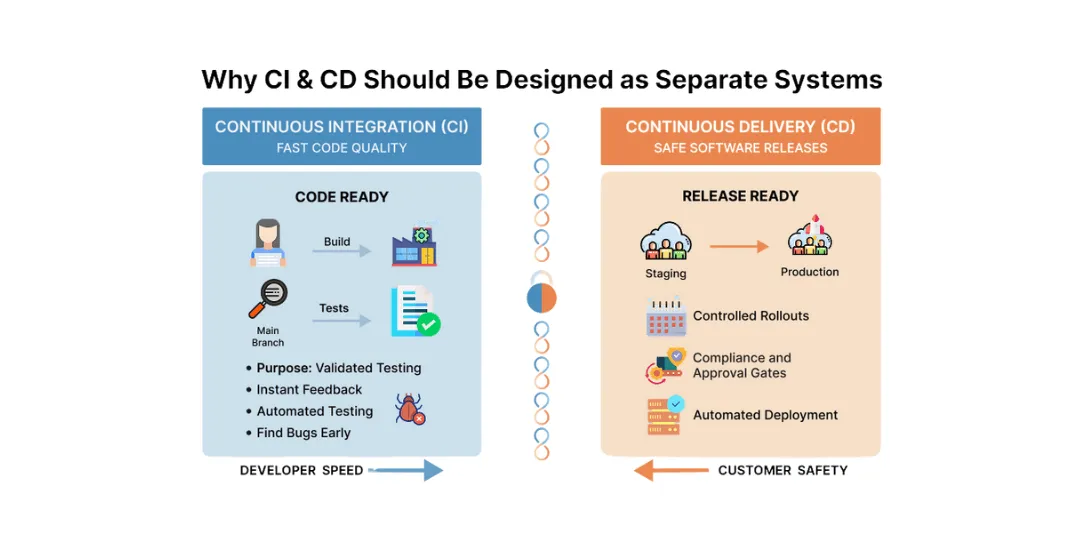
Structural Differences That Make CI and CD Separate Functions
| Area of concern | CI (Continuous Integration) | CD (Continuous Delivery / Deployment) |
|---|---|---|
| Primary Purpose | Validates code changes to ensure every commit is healthy, tested, and integrates cleanly. | Automates packaging, environment promotion, configuration, and deployment workflows. |
| Core Problem Solved | Detects integration issues early before they reach downstream environments. | Ensures code can move safely and consistently across environments into production. |
| Pipeline Frequency | Runs very frequently - on every commit or branch update. | Runs less frequently - aligned with release cycles or environment promotions. |
| Speed Requirement | Must be fast (minutes) to maintain developer feedback loops. | It can be slower because it includes provisioning, integration tests, security scans, and validations. |
| Impact of Failures | CI failures affect code quality and developer workflows. | CD failures affect environment stability, release readiness, and production safety. |
| Risk Profile | Low risk - breaks the build but not the environment. | High risk - can impact deployment pipelines and production systems. |
| Scalability Needs | Must scale horizontally with developer count and number of commits. | Must scale across multiple environments, clusters, artifacts, and deployment strategies. |
| Pipeline Health Focus | Fast builds, clean integrations, quick test cycles. | Reliable deployments, environment consistency, and controlled releases. |
| Troubleshooting | Identify and resolve root causes related to code issues or failed tests. | Surface issues related to infrastructure, configuration, environments, and deployments. |
| Observability | Build logs, unit test results, and linting reports. | Deployment logs, environment metrics, rollout status, and artifact promotion visibility. |
| Architecture Fit | Suited for developer-driven workflows and trunk-based development. | Suited for platform teams managing staging, production, and compliance gates. |
| Multi-Team / Microservices Fit | CI remains lightweight and independent for each service. | CD can be customized per service with environment-specific rules and compliance policies. |
| Autonomy Benefits | Developers get rapid feedback without waiting for deployment processes. | Ops/platform teams maintain safe, controlled deployments without being slowed by frequent commits. |
| Overall Goal | Keep the main branch stable and always in a deployable state. | Move validated code to production safely, predictably, and repeatably. |
Real-World Failure Modes
When CI and CD are tightly coupled, a single deployment failure can halt the entire engineering organization.
Let’s understand it with a small real-life scenario: if a production deployment step fails in a monolithic CI/CD pipeline, the whole pipeline is marked as failed - blocking every developer from merging code until the deployment issue is resolved. This creates unnecessary downtime, slows development velocity, and mixes developer concerns with operational failures.
By separating CI and CD, these failure modes are cleanly isolated.
CI continues running validation checks, allowing developers to merge, test, and ship code internally. Meanwhile, CD issues are contained within the deployment workflow, where platform or operations teams can investigate environment configuration, infrastructure errors, or rollout failures without impacting day-to-day development.
This separation ensures engineering productivity continues even when deployment problems occur, leading to far more resilient delivery operations.
Why This Separation Matters
By giving CI and CD their own responsibilities, the Organization avoids the typical pipeline bottlenecks teams face:
- CI remains fast and lightweight.
- CD remains safe and fully traceable.
- Rollbacks become trivial.
- Multi-environment and multi-tenant deployments become manageable.
- Debugging becomes simpler because every failure has a clear owner (CI issue vs CD issue).
This separation is not just a technical choice - it’s an organizational clarity choice. It keeps workflows predictable, environments stable, and engineers productive.
Conclusion
Separating CI and CD is not just a technical architecture choice-it directly impacts business performance. Fast, reliable CI accelerates developer productivity and reduces cycle time, allowing teams to ship features faster. A robust CD pipeline lowers deployment risk, improves release predictability, and reduces costly production incidents. Together, this separation shortens lead time, increases deployment frequency, improves system stability, and strengthen compliance. The result is a software delivery engine that scales with business growth, reduces operational overhead, and creates a measurable competitive advantage.
Frequently Asked Question
Get quick answers to common queries. Explore our FAQs for helpful insights and solutions.
Written by
Chandan Teekinavar
Chandan Teekinavar is a DevOps Engineer at Improwised Technologies. Passionate about Infrastructure as Code and CI/CD pipelines, he focuses on optimizing cloud deployments and enhancing the security and performance of modern applications. He plays a key role in ensuring high availability and driving DevOps best practices across projects
February 12, 2026
DevSecOps Architecture Explained: Security as Code, Policy Automation, and GitOps
Chintan Viradiya
Author

January 22, 2026
FluxCD with Helm: Scaling Platform Governance via GitOps Reconciliation
Chintan Viradiya
Author
January 19, 2026
Site Reliability Engineering in Practice: Building Reliable Systems at Scale
Annavar Satish
Author

Optimize Your Cloud. Cut Costs. Accelerate Performance.
Struggling with slow deployments and rising cloud costs?
Our tailored platform engineering solutions enhance efficiency, boost speed, and reduce expenses.