
April 16, 2026
What Production Incidents Reveal About Your System Maturity?

Hussain Gandhi
Author

Shyam Kapdi
Contributor

Shailesh Davara
Reviewer
Normal operations hide a lot. When nothing is breaking, almost every system looks functional. The real state of a system - how well it is designed, documented, and understood - only becomes organized when something goes wrong.
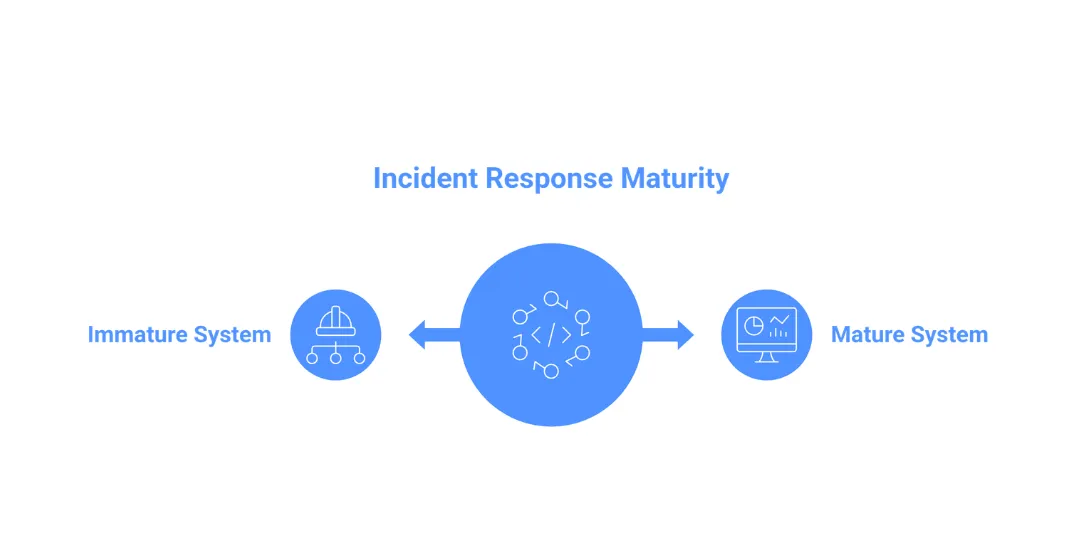
What the first 15 minutes of an incident reveal
In the first 15 minutes of a production incident, three things become immediately visible.
First: Does the team know where to look? In an organized system, monitoring surfaces the problem directly. Engineers go to a dashboard, read an alert, and understand what is failing. In an unorganized system, the first 15 minutes are spent figuring out where to start.
Second: Does the team know how to communicate? In an organized system, there is a defined incident process. Someone takes the coordinator role. Updates go to a known channel. Stakeholders are notified on a defined schedule. In an unorganized system, this gets improvised. People are pinging different channels. Leadership is asking for updates in three different places. The team is handling the incident and communication simultaneously.
Third: Are there documented runbooks? Organized systems document common failures so engineers follow procedures rather than memory. In unorganized systems, knowledge is undocumented. If the key person is unavailable, the incident takes longer to fix.
The difference between resolving an incident and understanding it
Most teams can eventually resolve an incident. The question is how.
| Unorganized System | Organized System |
|---|---|
| Resolution depends on memory, intuition, and trial and error. | Resolution produces a Organized account of what happened. |
| The team fixes the immediate problem and moves on. | The team explains why the incident happened. |
| Nobody is certain why it happened or if the fix addresses the root cause. | The team identifies the root cause of the failure. |
| There is no record of what the system actually did in response. | The account shows exactly how the system responded. |
| The incident is resolved, but no learning is carried forward. | The account becomes the basis for a post-incident review. |
| The same failure mode appears again months later. | The process prevents the same failure from happening again. |
| The team remains permanently reactive. | The system creates the conditions for learning and improvement. |
What post-incident reviews reveal about the system
A post-incident review that consistently produces action items like “we need better documentation” or “the on-call engineer did not know how this service works” is telling you something specific: operational knowledge is not in the system. It is in people. And when those people are not available, incidents take longer and cost more.
A review that consistently produces action items like “we need to add this alert” or “this failure mode is not covered by our runbooks” is more organized. The team knows what the system does and does not cover. They are closing specific gaps.
A review that identifies a change to the underlying system or platform that prevents the failure class entirely is the most organized response. The team is treating incidents as information about system design, not just operational problems to recover from.
The quality of your post-incident action items is a direct indicator of where the system is and where it needs investment.
Why do incident patterns repeat in Unorganized systems
Incidents repeat when the conditions that caused them are not changed.
In a system where knowledge lives in people rather than documentation, incidents caused by knowledge gaps will recur whenever the person with the knowledge is not on call. In a system where monitoring is incomplete, incidents caused by undetected failures will recur until the monitoring is added. In a system where deployment processes are inconsistent, deployment-related incidents will appear in different forms across different teams.
The pattern of recurring incidents is not bad luck. It is a direct map of where the system has not been built to carry its own operational knowledge.
Most organizations treat each incident as a one-time event. The more useful frame is: each incident is the system showing you a specific gap. If that gap is not addressed at the system level, the incident will return.
The difference between being on call and being prepared
In an unorganized system, being on call means being available to use personal knowledge to fix things when they break. The on-call rotation is effectively a way of distributing the obligation to be available, not a way of distributing the ability to respond effectively.
If the most experienced engineer is on call, incidents get resolved faster. If a newer engineer is on call, incidents take longer. The difference in resolution time is a measure of how much the system depends on individual knowledge rather than a documented process.
In a Organized system, the on-call rotation distributes genuine capability, not just availability. A newer engineer following documented runbooks in a well-monitored system can handle most incidents that a senior engineer would handle. The senior engineer’s expertise built the runbooks and the monitoring. The system carries that expertise forward.
The maturity test
Take any significant incident from the last six months. Ask two questions.
One: When the incident started, did the first responder know immediately where to look, or did they spend time figuring out where to start?
Two: Did the post-incident review result in a documented change to the system, the platform, or the process - not a commitment to be more careful, but an actual structural change?
If the answer to both is yes, the system is learning. If the answer to either is no, the conditions that produced the incident are still in place.
Look at your last three production incidents. Did each one result in a structural change to the system, or a note to be more careful next time?
We build open source platforms that make incident patterns visible and addressable at the system level, so that on-call engineers are working with documented runbooks and consistent monitoring rather than personal memory. More at www.improwised.com
Frequently Asked Question
Get quick answers to common queries. Explore our FAQs for helpful insights and solutions.
A production incident reveals how well the system is designed, monitored, and documented. It exposes whether teams can quickly identify issues, follow defined processes, and rely on system-level knowledge instead of individual memory.
In the first 15 minutes, teams should be able to identify the issue through monitoring, follow a defined communication process, and execute documented runbooks without guessing where to start.
Unorganized systems lack structured monitoring, organized communication protocols, and documented runbooks. This forces engineers to rely on intuition and trial and error, which increases resolution time and confusion.
Monitoring helps engineers immediately identify failures by surfacing actionable alerts and dashboards, and without it, teams waste time figuring out where the issue exists instead of resolving it.
Runbooks provide step-by-step procedures for handling known failure scenarios. They reduce dependency on individual expertise and allow any on-call engineer to respond effectively.
Resolving an incident restores system functionality, while understanding it explains why it happened and how to prevent it. Organize systems, prioritize root cause clarity, not just quick fixes.
Written by
Hussain Gandhi
Hussain Gandhi is a DevOps Engineer at Improwised Technologies Pvt Ltd. He focuses on building scalable systems through automation and scripting. He has hands-on experience with cloud infrastructure, CI/CD pipelines, and infrastructure as code. Hussain combines strong technical skills with a collaborative work style. In his free time, he enjoys learning new things.

September 18, 2026
What Platform Engineering Services Actually Include
Chintan Viradiya
Author

September 16, 2026
What Actually Slows Kubernetes Down (And What to Fix Before Adding Nodes)
Hussain Gandhi
Author


September 10, 2026
What Off-Premise Migration Actually Involves (And What It Costs)
Chandan Teekinavar
Author

Optimize Your Cloud. Cut Costs. Accelerate Performance.
Struggling with slow deployments and rising cloud costs?
Our platform engineering solutions are built on open-source tools and use AI natively across the workflow.