
May 14, 2026
Why Cloud Cost Reductions Fail After 90 Days

Hussain Gandhi
Author

Shyam Kapdi
Contributor

Shailesh Davara
Reviewer
The Architecture Loop Nobody Talks About
Most companies spend 6–12 months running FinOps programs and see costs drop, then watch them creep back up within a quarter. This is not a discipline problem. It is an architecture problem.
I have seen this happen at companies of every size, 50 engineers, 400 engineers, and everything in between. The cloud bill goes down after the first optimization sprint. Everyone feels good. Then three months later, the numbers are back where they started, sometimes higher.
After 15 years of running cloud infrastructure businesses, I can tell you why this keeps happening. And it is not because your FinOps team is doing a bad job.
1. Operational Waste vs. Structural Waste - Why the Difference Matters
Operational waste is easy to see. Unused instances are sitting idle. A dev environment running on weekends. An oversized database nobody downsized after the migration. Your FinOps dashboards catch these. Your team fixes them. Costs drop.
Structural waste is invisible on those same dashboards. It is baked into how your systems were designed and how new infrastructure gets created. Every time a new service goes live, every time a team spins up a new environment, the same architectural decisions that created waste last quarter create it again this quarter.
Think of it this way. Operational fixes clean the floor. Structural problems include a leaking pipe in the ceiling. You can mop every day, and the floor will still be wet.
The most common structural drivers I see:
- Service sprawl — teams building independent micro-services, each with their own databases, caches, and compute, none of which is sized or shared efficiently
- Shared infrastructure that nobody owns — resources provisioned for a project that finished two years ago, still running because no team is accountable for turning them off
- No lifecycle policies — infrastructure created with no automated expiry, no cleanup rules, no end-of-life trigger
- Cost-blind design — engineers designing systems where cost was never a design constraint, only performance and delivery speed
2. The Four Architectural Patterns That Cut Cloud Costs Fastest
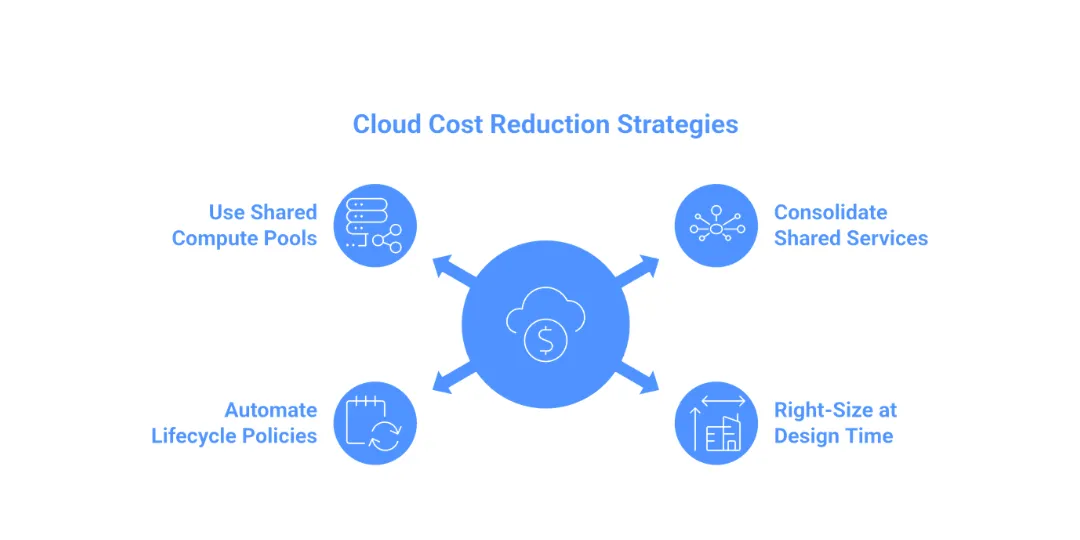
When I work with companies on structural cost reduction, four changes move the needle faster than anything else:
First — consolidate shared services. Instead of every product team running their own message queue, cache layer, or logging infrastructure, build shared platforms that they plug into. This alone can cut 20–30% of infrastructure spending by 20–30% in mid-size companies.
Second — right-size at design time, not after launch. When engineers select instance types and storage tiers during architecture design, they almost always overprovision. Build a simple checklist into your design review process that requires cost justification for every major infrastructure choice.
Third — automate lifecycle policies at provisioning. Every environment created should have a default expiry or a required owner. Non-production environments should shut down automatically on a schedule. This is not hard to build. Most teams just never prioritize it.
Fourth — use shared compute pools. Instead of dedicated compute per service, move workloads onto shared node pools or container platforms where bin-packing happens automatically. As seen in our recent infrastructure transformation case studies, this is one of the highest-ROI changes a platform team can make.
3. Why FinOps Programs Plateau After the First Sprint
FinOps programs are designed to identify and eliminate existing waste. They are not designed to stop waste from being created. That is the gap.
After the first sprint, the obvious waste is gone. What is left is structural, and structural waste regenerates. New services get built the same way old ones were. New environments get provisioned without lifecycle rules. The architecture loop restarts.
The 20–40% of cloud spend that most FinOps dashboards never surface comes from decisions made before a single line of code is written — at the design and provisioning layer.
I have watched companies invest heavily in FinOps tooling and cloud management strategies, hire dedicated FinOps practitioners, and still watch costs climb 15–20% year over year.
FinOps tells you what is happening. It does not change how new infrastructure gets born into the world.
4. What Cost Governance at the Provisioning Layer Actually Looks Like
This is not about adding bureaucracy to your engineering process. It is about building cost constraints into the tools and workflows your engineers already use.
Practical examples of what this looks like in practice:
- Infrastructure templates with cost tiers built in — engineers pick from pre-approved patterns, not blank-canvas configuration.
- Automated tagging enforcement — no resource can be created without an owner, a cost center, and an environment label attached.
- Cost estimates in pull requests — before infrastructure changes are merged, an automated check shows the estimated monthly cost delta.
- Quota limits per team — teams have a provisioning budget. Going over it requires approval, not just a ticket.
- Non-production shutdown policies — dev and staging environments default to off outside business hours unless explicitly overridden.
None of these requires a completely new platform or a six-month implementation. With the right platform engineering services, most can be built with existing CI/CD pipelines and infrastructure-as-code tooling your teams already have.
The cultural piece matters more than the tooling. Engineers need to know that cost is a first-class concern at design time, not something Finance surfaces on a dashboard three months later.
5. A 90-Day Structural Cost Reduction Plan That Does Not Slow Delivery
DAYS 1–30 — DIAGNOSE
Audit your current architectural patterns. Where is infrastructure being created without lifecycle rules? Where are teams running redundant shared services? Where are design processes happening with no cost input? Get a clear picture before touching anything.
DAYS 31–60 — BUILD THE GUARDRAILS
Pick the two or three structural changes with the highest impact. Usually, that is shared services consolidation and automated lifecycle policies. Build these into your provisioning workflow. Make the default path the cost-efficient path. Do not ask engineers to do the right thing, but manually automate it.
DAYS 61–90 — MEASURE AND LOCK IN
Measure new spend creation, not just existing spend. Are new services being provisioned more efficiently? Are lifecycle policies actually triggering? Is the architecture review process catching cost-blind designs before they ship? Adjust and close the gaps.
This plan works alongside your existing delivery roadmap. It does not require a freeze on new features or a separate transformation program. It requires two things: someone with the authority to set design standards, and the will to enforce them.
Conclusion
Cloud cost reduction that sticks is not about cleaning up what exists. It is about changing how new things get built.
The companies that break the 90-day cost cycle are the ones that stop treating cloud spend as an operational problem and start treating it as an architectural one. That shift starts with leadership, not dashboards.
If your cloud costs keep coming back after every optimization sprint, the answer is not more sprints. The answer is changing the conditions that create the waste in the first place. Contact our team today to schedule an architectural review and stop the cycle of structural cloud waste.
Frequently Asked Question
Get quick answers to common queries. Explore our FAQs for helpful insights and solutions.
Most fail because companies fix operational waste temporarily without addressing structural architectural inefficiencies.
Structural cloud waste comes from inefficient architecture decisions, redundant services, and missing lifecycle governance.
No. FinOps identifies waste, but architecture and provisioning governance prevent new waste from being created.
Platform engineering standardizes infrastructure, improves resource sharing, and automates governance policies.
Combining FinOps, lifecycle automation, shared services, and cost-aware architecture reviews.
Written by
Hussain Gandhi
Hussain Gandhi is a DevOps Engineer at Improwised Technologies Pvt Ltd. He focuses on building scalable systems through automation and scripting. He has hands-on experience with cloud infrastructure, CI/CD pipelines, and infrastructure as code. Hussain combines strong technical skills with a collaborative work style. In his free time, he enjoys learning new things.


September 18, 2026
What Platform Engineering Services Actually Include
Chintan Viradiya
Author

September 16, 2026
What Actually Slows Kubernetes Down (And What to Fix Before Adding Nodes)
Hussain Gandhi
Author


September 10, 2026
What Off-Premise Migration Actually Involves (And What It Costs)
Chandan Teekinavar
Author

Optimize Your Cloud. Cut Costs. Accelerate Performance.
Struggling with slow deployments and rising cloud costs?
Our platform engineering solutions are built on open-source tools and use AI natively across the workflow.