
June 6, 2026
Five Architecture Decisions That Eliminate Security Risk Before You Need a Tool

Chandan Teekinavar
Author

Shyam Kapdi
Contributor

Shailesh Davara
Reviewer
Why your security surface area keeps growing, and the design choices that stop it.
After 15 years of running cloud infrastructure and platform engineering teams, I’ve sat in more security review meetings than I can count. The conversations follow the same pattern every time.
Leadership asks why the attack surface continues to grow. Engineering says it is a resource problem. Security recommends a new tool. The tool gets purchased. Six months later, the same conversation happens again.
Here is what I’ve learned after watching this cycle across multiple companies: the problem was never the tools. The problem was what we built before anyone thought about security.
Security tool purchases fix risks that architecture decisions created. The teams with the smallest attack surface didn’t buy better tools. They made different design decisions.
This is what I want to talk about today.
Why Security Tools Are Always Playing Catch-Up
Most security tools exist to manage a problem that has already happened. Someone stored credentials in a config file. An API was built without rate limiting. A service got too many permissions because it was “faster that way.” A third-party library with a known vulnerability sat in production for nine months because no one was tracking it.
Each of these is now a product category. Secrets scanning tools. API gateways. Permission auditing. Software composition analysis.
These tools are genuinely useful. I am not arguing against using them. But notice what each one does: it detects or manages a problem that was created during development. It is downstream of the decision.
The security budget question most companies are asking is: Which tools should we buy? The question they should be asking is: why does our architecture keep producing these risks?
Here is the honest answer: when the secure path is harder than the insecure one, developers will take the easy path. Not because they are careless. Because they are under a deadline, the sprint ends Friday, and the vault integration tutorial is twelve steps long.
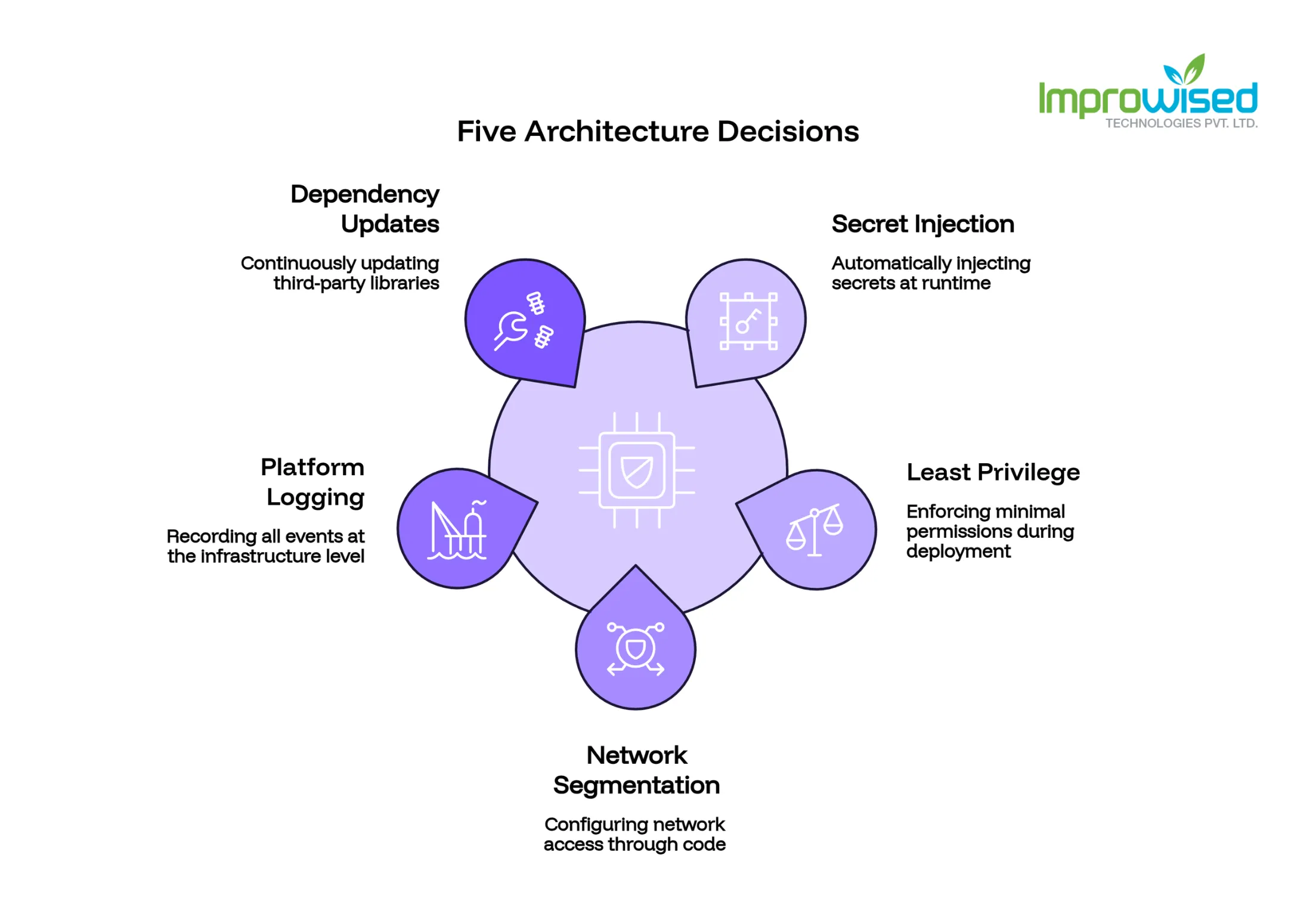
The Five Architecture Decisions With the Highest Security Return
These are not theoretical. These are the decisions I have seen make the largest practical difference in how a platform produces or reduces security risk over time.
1. Make secret injection the default, not the option
Most platforms let developers use secrets management tools. The good ones make it impossible not to. When a service is deployed, the secrets it needs should arrive through the environment automatically pulled from the vault at runtime, not copied into a config file by a developer at 11 pm before a release.
The moment a developer has to manually handle a credential, you have introduced a decision point. Decision points produce mistakes. Remove the decision point.
2. Build least-privilege into the deployment process, not the policy document
Every company has a least-privilege policy. Almost no company enforces it consistently, because enforcement depends on someone checking. That person is busy. The deployment already went out.
When the platform controls what permissions a service can request and rejects anything that exceeds what the service definition specifies, least privilege becomes a constraint, not a guideline. If you want to see exactly how to implement this using Policy as Code and OPA, read our technical breakdown on DevSecOps Architecture and GitOps Automation. The conversation shifts from “we should reduce permissions” to “the build won’t pass with those permissions.”
3. Treat network segmentation as a deployment configuration, not a network team request
In most organizations, a developer who needs a service to communicate with another service opens a ticket. The ticket sits in a queue. Eventually, someone from the network team opens a firewall rule. The rule is often broader than it needs to be, because the requester didn’t know exactly what to ask for, and the network team doesn’t know the application well enough to challenge it.
When network policy lives in code, when a service declares what it talks to, and the platform enforces it, this gets much tighter. The developer has context. The platform has authority. The rule is specific.
4. Log everything at the platform level, not the application level
Application-level logging depends on developers remembering to add it. Platform-level logging happens regardless of what the developer did or didn’t think about. Every API call, every authentication event, every permission check gets recorded at the infrastructure layer automatically.
This matters not just for incident response, but for visibility. You cannot improve what you cannot see. Most teams have very poor visibility into what their systems are actually doing because logging was a feature, not a platform default.
5. Make dependency updates a continuous process, not a quarterly project
Vulnerabilities in third-party libraries are one of the most common attack vectors. They are also one of the most preventable. The reason teams end up running software with known vulnerabilities for months is almost always the same: updates require manual work, manual work requires scheduling, and scheduling competes with features.
When dependency scanning and update proposals are automated when a pull request appears with the updated library and a passing test suite, the cost of staying current drops to almost nothing. The organizations with the smallest vulnerability windows didn’t have better security discipline. They automated the boring part. For example, we used this exact GitOps automation approach to secure and scale deployments for a leading Hospital Management System handling sensitive patient records.
How to Make the Secure Path the Default Path
The pattern across all five decisions is the same: move security from something developers choose to do to something the platform does by default. This is the core philosophy behind our Platform Engineering Services. We build the ‘paved road’ so developers don’t have to navigate security minefields manually.
This is not about trusting developers less. It is about building systems where the expected behavior is the secure behavior. When a developer joins a team and follows the standard process, they should automatically get secrets injection, appropriate permissions, network segmentation, and audit logging without reading a security guide.
The question worth asking about your platform: does the standard path produce secure outcomes, or does it produce convenient ones that someone will have to clean up later?
The teams that have the smallest security surface area are not the ones with the most security training. They are the ones whose platform makes insecure choices harder than secure ones.
Measuring Security Posture Without Buying a Tool
If you want to understand where you actually stand, here are four questions that give you a realistic picture, no tool purchase required:
-
How many services in production have permissions they don’t use? If you don’t know, that is the answer.
-
What percentage of your secrets are stored somewhere other than your secrets management system? Survey five developers and see what they say.
-
If a credential were compromised today, how long would it take you to know? How long would it take you to rotate every place it’s used?
-
How old is the oldest unpatched critical vulnerability in your production dependencies? If this requires a manual search to answer, that tells you something.
These are not tool metrics. They are architecture metrics. The answers tell you whether your design choices are producing a security risk or reducing it. If you want a comprehensive look at how your current setup scores across deployment, observability, and security, take our free Platform Engineering Maturity Assessment.
Secrets Sprawl Is a Platform Problem, Not a People Problem
I want to be direct about this because I see organizations waste a lot of time on the wrong solution.
When credentials end up in source code, in Slack messages, in shared spreadsheets, the instinct is to blame the developer who did it and send the team through security awareness training. Sometimes organizations buy a secrets scanning tool to catch it after the fact.
Neither of these addresses what actually happened. A developer needed a credential. The right way to get it was harder than the wrong way. So they took the wrong way, not because they wanted to create a security problem, but because they needed to finish the task in front of them.
Secrets sprawl is not a discipline problem. It is a design problem. When you fix the design, getting a credential the right way takes thirty seconds instead of thirty minutes; the wrong way stops being attractive.
This is the shift I’m asking engineering leaders to make: stop debugging developer behavior and start debugging the systems that produce that behavior.
The Real Question Is When You Make This Decision
Security decisions made at design time are cheap. The same decisions made after the fact, after the architecture is built, after the services are deployed, after the developers have habits, are very expensive.
Every week, a team runs without platform-level secrets injection, without automated dependency updates, without declarative network policy; they are accumulating technical security debt. Debt that eventually gets paid either through remediation projects or through incidents.
The teams I’ve seen get this right didn’t have bigger security budgets. They just decided, earlier, that security was a platform responsibility and not a developer discipline problem.
That decision is available to any team, at any stage. The earlier it gets made, the less it costs.
What does your platform make the default: the secure path or the convenient one? If you’re ready to stop buying tools and start fixing the architecture, contact us today to see how we can secure your platform by design.
Frequently Asked Question
Get quick answers to common queries. Explore our FAQs for helpful insights and solutions.
Security tools like secrets scanners and API gateways are downstream solutions that only detect problems after they are created. To actually stop your attack surface from growing, you must fix the underlying platform architecture. When you build a paved road where secure design is the default, your team naturally avoids the insecure choices that require expensive monitoring tools to clean up later.
Stop treating secrets sprawl as a developer discipline problem and treat it as a platform design problem. You must make a secret injection of the platform default. When your deployment architecture automatically pulls and injects credentials from the vault at runtime, you eliminate the manual decision points that force engineers to handle credentials under tight sprint deadlines.
Build least-privilege directly into your deployment pipeline using Policy as Code. Instead of relying on manual security audits after a service is deployed, configure your platform to automatically reject any build that requests permissions exceeding its exact service definition. This transforms least-privilege from an easily ignored guideline into a hard deployment constraint.
Move network segmentation out of manual IT ticketing queues and directly into your deployment configuration. When network policy lives in code, a service explicitly declares what it needs to communicate with, and the platform automatically enforces that specific rule. This eliminates the overly broad, risky firewall rules that get approved simply to clear a ticket backlog.
Transform dependency updates from a manual, quarterly chore into a continuous, automated pipeline. By configuring your CI/CD platform to automatically scan dependencies and generate pull requests alongside passing test suites for new libraries, you reduce the engineering cost of staying current to near zero and close critical vulnerability windows immediately.
Written by
Chandan Teekinavar
Chandan Teekinavar is a DevOps Engineer at Improwised Technologies. Passionate about Infrastructure as Code and CI/CD pipelines, he focuses on optimizing cloud deployments and enhancing the security and performance of modern applications. He plays a key role in ensuring high availability and driving DevOps best practices across projects


September 18, 2026
What Platform Engineering Services Actually Include
Chintan Viradiya
Author



September 16, 2026
What Actually Slows Kubernetes Down (And What to Fix Before Adding Nodes)
Hussain Gandhi
Author



September 10, 2026
What Off-Premise Migration Actually Involves (And What It Costs)
Chandan Teekinavar
Author
Optimize Your Cloud. Cut Costs. Accelerate Performance.
Struggling with slow deployments and rising cloud costs?
Our platform engineering solutions are built on open-source tools and use AI natively across the workflow.