
August 25, 2026
Open Source AI Models Are Ready. Is Your Team?

Chandan Teekinavar
Author

Shyam Kapdi
Contributor

Shailesh Davara
Reviewer
Open Source AI Models Are Good Enough Now. The Real Question Is Whether Your Team Can Run Them.
Something changed in the last twelve months, and most companies still haven’t caught up to it.
A year ago, open-source AI was the backup option. You used it for simple tasks, basic classification, low-stakes chatbots, things where quality didn’t matter that much. Anything serious went to a closed model from a big provider, because that was the only option that actually worked well.
That gap has closed. Fast.
DeepSeek matched GPT-4-level performance on real benchmarks at a fraction of the training cost. Llama 3 is already running production workloads inside companies with 500+ engineers. Qwen 2.5 handles code and structured data extremely well. None of this is a lab experiment anymore. It’s in production today, doing real work.
Here’s the part that doesn’t get said enough: the model being good enough is not the same as your company being ready to use it.
The cost savings on open-source AI can be real, sometimes 10x to 100x cheaper depending on the task. But almost none of that saving shows up automatically. It shows up only if your team knows how to deploy, monitor, and maintain these models properly. If they don’t, you don’t save money. You just move your problems from a vendor invoice to your own infrastructure bill.
This is a decision for the top of the company, not just engineering. Here’s why.
Open Source First Doesn’t Mean “Never Pay for AI”
Let’s be direct about what this actually means, because it gets misunderstood constantly.
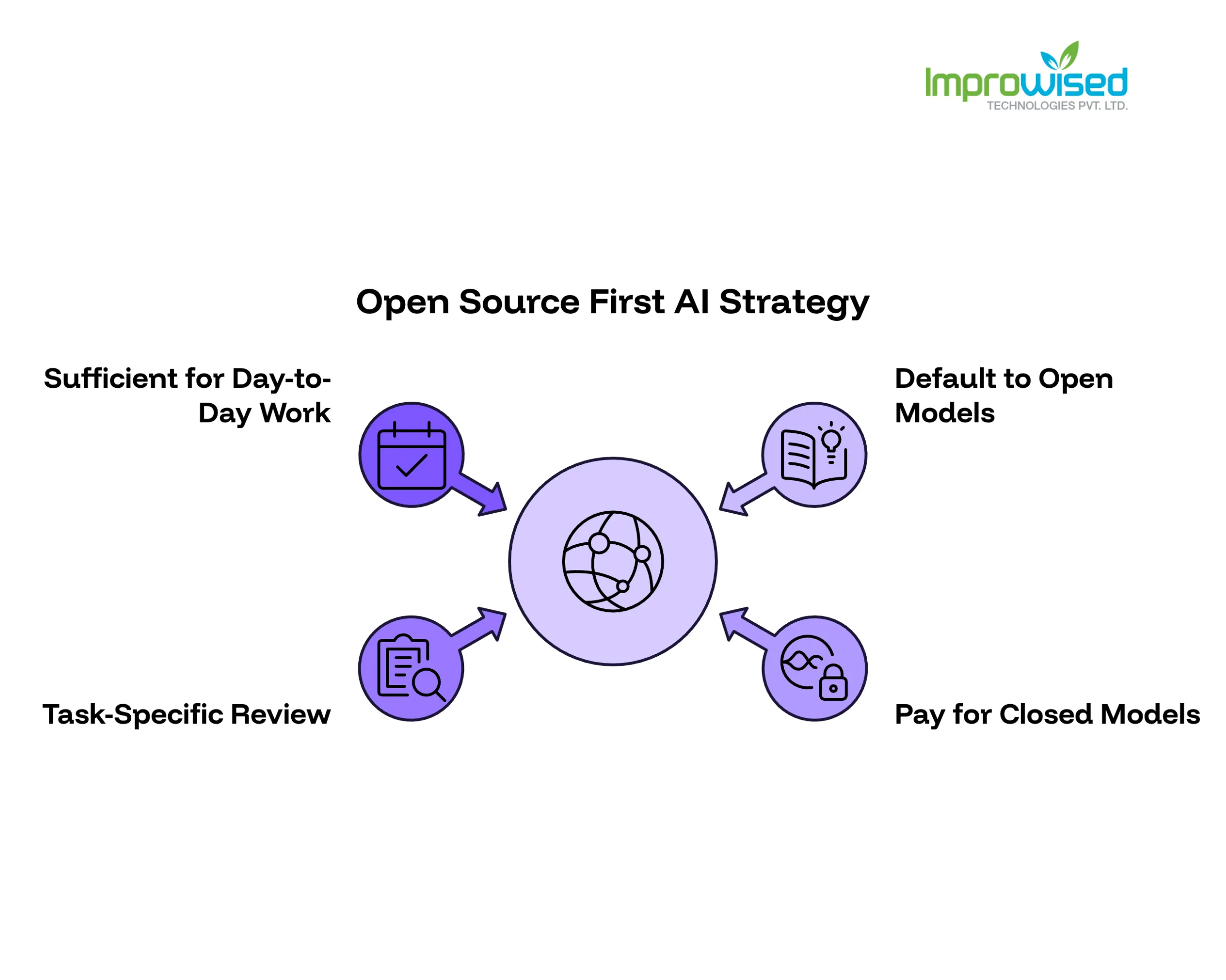
“Open source first” does not mean cutting off every paid AI vendor. It means changing your default:
- Default to an open model. Use it unless there’s a clear, provable reason not to.
- Pay for a closed model only when the quality gap justifies the cost. Not out of habit. Not because it’s the safe brand-name choice.
- Review this decision by task, not by company-wide policy. A customer support bot and a complex coding agent do not have the same requirements.
For most day-to-day enterprise work, summarizing documents, tagging support tickets, reviewing code, and searching internal knowledge bases, open models are already sufficient. You don’t need the most expensive model on the market to summarize a PDF.
Where closed models still hold an edge:
- Multi-step reasoning agents that plan, execute, and correct themselves across many steps
- Novel, complex code generation where a mistake is expensive
- Tasks where a small quality drop has a large business cost
Everything else is a candidate for open source. That’s the honest split, not a marketing pitch either way.
The Real Cost of Self-Hosting (Nobody Talks About This Part)
This is where most companies get the math wrong. Open-source models are free to download. Running them is not free at all.
What you’re actually paying for when you self-host:
- GPU compute. Running something like Llama 70B on cloud infrastructure has a real, ongoing bill. It is not zero.
- Serving infrastructure. Tools like vLLM or Ollama don’t run themselves. Someone has to set them up, tune them, and keep them stable.
- Engineering time. This is the cost people forget. Every hour your team spends maintaining model infrastructure is an hour not spent building your actual product.
- Monitoring and failure handling. What happens when the model is slow, returns a bad answer, or goes down at 2 AM? Someone has to own that.
Here’s the number that matters: if you’re spending $50,000 or more per month on API calls to providers like OpenAI or Anthropic, and as we’ve noted before, most teams need to start tracking what matters to stop burning cash on AI tokens. Self-hosting usually pays for itself in 3 to 6 months. Below that spend level, the math often doesn’t favor self-hosting yet; the engineering overhead eats the savings.
Run this calculation before you commit to anything. Don’t assume “open source” automatically means “cheaper.” It means cheaper only at the right scale, with the right team.
The Infrastructure You Actually Need to Make This Work
This is the piece that gets skipped, and it’s the piece that determines whether this whole strategy succeeds or quietly fails.
Three things you need in place before you go multi-model:
- A model gateway. Tools like LiteLLM or PortKey let you route requests between different models without rewriting your application code every time you switch. Without this, every model change becomes an engineering project.
- Observability. You need to track token usage, latency, and cost, broken down per model, per use case. If you can’t see this, you can’t manage it. You’re flying blind on your own AI spend.
- A fallback policy. If the open model is slow, down, or returns a bad result, the system should automatically route the request to a closed model. This has to be automatic, not something an engineer notices and fixes manually three hours later.
Without these three things, “open source first” turns into a mess of one-off integrations that nobody wants to maintain six months from now. If you are unsure whether your current infrastructure team is equipped to handle this level of observability and routing, take our free Platform Engineering Maturity Assessment to find out. Building this resilient, swap-ready architecture is the core focus of our Platform Engineering Services.
Why This Matters Even More If You Operate in the US, Europe, or India
This isn’t only a cost conversation. It’s a legal and data-control conversation too.
- EU AI Act: Using open models with documented, traceable training data gives you a clearer, easier path to compliance than a black-box closed model.
- India’s DPDP Act: Data residency requirements make self-hosted models a strong option for sensitive workloads that can’t leave your own infrastructure.
- GDPR and US data privacy law: Sending user data to a third-party API, especially one hosted outside your legal jurisdiction, creates real legal exposure. A model running inside your own cloud environment does not carry that same risk.
If your company handles healthcare data, financial data, or any regulated personal information, this stops being a technical preference. It becomes a compliance decision that your legal and security teams should be part of from day one, not brought in after the infrastructure is already built.
Conclusion
Open source first is not a cost-cutting trick. Treat it that way, and you’ll be disappointed by the results.
It’s an architecture decision. Done right, it gives you control over three things at once: what you spend, where your data lives, and how you meet compliance requirements, instead of being locked into one vendor’s pricing, policies, and roadmap.
The companies getting this right in 2026 are not the ones that picked the single best-performing model. They’re the ones who built infrastructure that lets them swap models in and out without breaking anything else. See how we engineered this exact kind of flexibility in our case study for a leading Cloud-Native AI Orchestration Platform. That’s the actual skill. The model is replaceable. The infrastructure and the team that runs it are not.
If your engineering team can’t answer, right now, “which of our AI workloads could move to an open model today, and what would it cost us to run them”, that’s the gap to close first. Before the next model release. Before the next vendor price increase. Contact us today to evaluate your AI workloads and build an open-source-first infrastructure.
Frequently Asked Question
Get quick answers to common queries. Explore our FAQs for helpful insights and solutions.
For most enterprise tasks, summarization, classification, code review, document analysis, and internal search, yes, open models now perform at a comparable level. For complex multi-step reasoning and advanced agentic tasks, closed models still hold an edge. The right approach is matching the model to the task, not picking one model for everything.
It depends on your usage volume. If your monthly spend on AI APIs is above roughly $50,000, self-hosting typically pays for itself within 3 to 6 months. Below that threshold, the engineering and infrastructure overhead often outweighs the savings. Calculate your break-even point before committing.
Engineering time. GPU compute and serving tools like vLLM or Ollama have visible costs, but the ongoing work of maintaining, monitoring, and fixing that infrastructure is the cost most companies underestimate. It's a continuous commitment, not a one-time setup.
DeepSeek V3 currently leads among open models specifically for coding benchmarks. Qwen 2.5 is also strong for code and structured output. The right choice still depends on your specific use case and infrastructure constraints.
Yes, in most cases. Self-hosted open models keep data inside your own infrastructure, which reduces the legal exposure that comes with sending user data to a third-party API outside your jurisdiction. Open models with documented training data also make EU AI Act compliance more straightforward than closed, black-box models.
Three things, at minimum: a model gateway to route requests across models without rewriting application code, observability to track cost, latency, and usage per model, and an automatic fallback policy to a closed model when the open model fails or underperforms.
No. 'Open source first' means defaulting to open models where they meet the quality bar and reserving closed models for tasks where the performance gap clearly justifies the extra cost. It's a task-by-task decision, not an all-or-nothing policy.
Written by
Chandan Teekinavar
Chandan Teekinavar is a DevOps Engineer at Improwised Technologies. Passionate about Infrastructure as Code and CI/CD pipelines, he focuses on optimizing cloud deployments and enhancing the security and performance of modern applications. He plays a key role in ensuring high availability and driving DevOps best practices across projects



Optimize Your Cloud. Cut Costs. Accelerate Performance.
Struggling with slow deployments and rising cloud costs?
Our platform engineering solutions are built on open-source tools and use AI natively across the workflow.