
August 18, 2026
AI Agents Talking to Each Other?

Hussain Gandhi
Author

Shyam Kapdi
Contributor

Shailesh Davara
Reviewer
Your AI Agents Are Talking to Each Other. Who’s Watching?
“Autonomous AI agent” is not the same thing as “innovation.” It’s a question that needs an answer before deployment: who signs off before something bad happens?
Right now, companies are building autonomous AI agents and chaining them together. One agent pulls data. One agent writes a draft. One agent sends it out to a customer, a vendor, or a database. Each handoff looks fine on its own. Nobody’s checking what happens between them.
That gap is where the damage starts.
The Problem Isn’t the AI. It’s the Silence Between Agents
Here’s what actually happens in a multi-agent chain:
- Agent A researches a customer’s account and hands off a summary.
- Agent B reads that summary and drafts a refund, a contract change, or an email.
- Agent C sends it, no human in between.
If Agent A got one detail wrong, Agent B builds on that wrong detail. Agent C executes it. Nobody sees the mistake until a customer, a vendor, or an auditor points it out.
This isn’t a hypothetical. It’s how every broken handoff in a chain of command has ever worked, human or machine. The only difference now is speed. A bad instruction that used to take a day to cause damage can now cause damage in seconds.
The core issue: “autonomous” gets misread as “unsupervised.” It shouldn’t. Autonomous means the agent can move through steps without you prompting it at every turn. It does not mean you remove checkpoints. Those are two different decisions, and companies are quietly merging them into one.
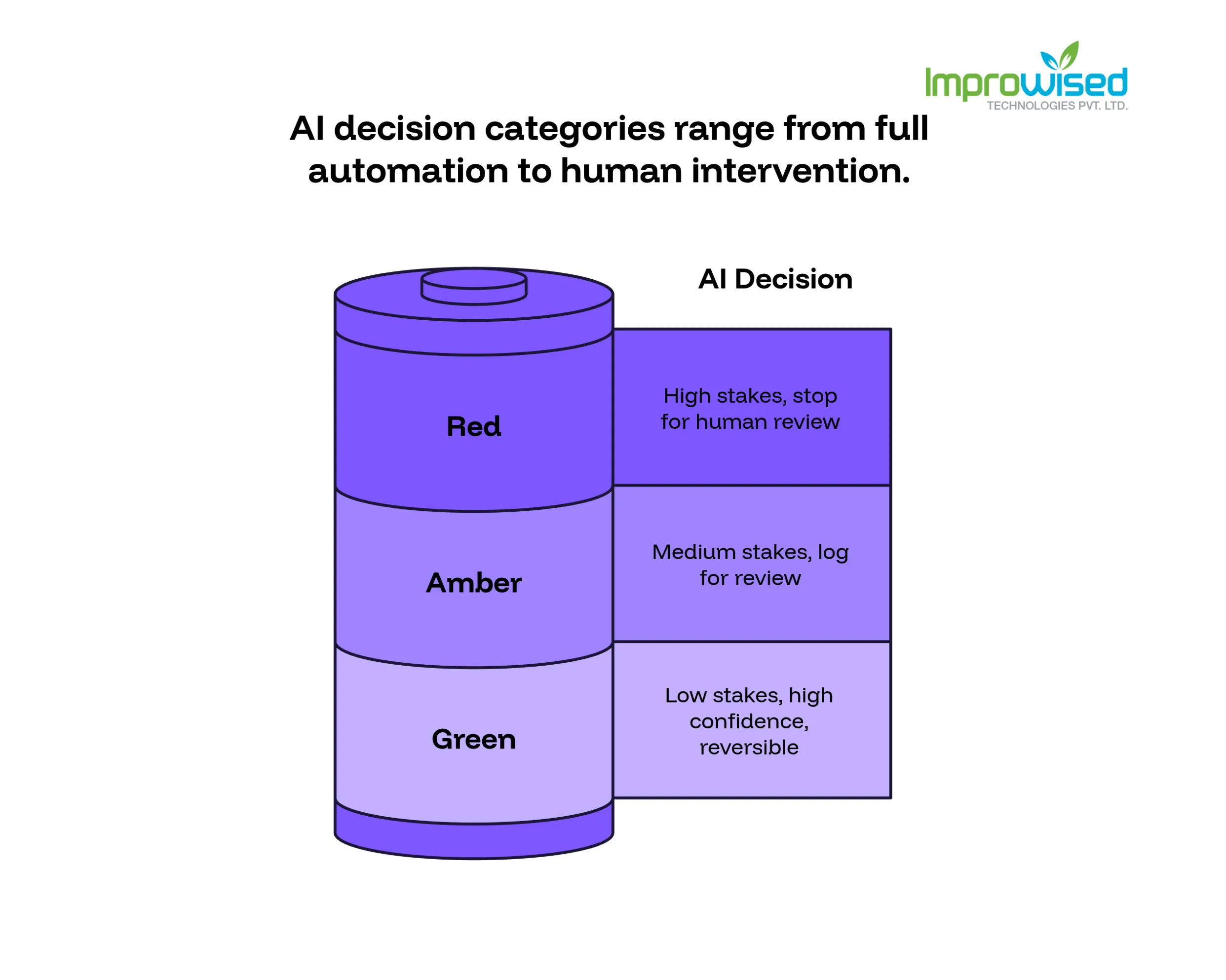
Every AI Decision Falls Into One of Three Buckets
AI agents shouldn’t be trusted or distrusted as a whole. They should be managed by classifying what each one is about to do. Every action an agent can take fits into one of three categories:
🟢 Green - Automate it fully. Low stakes. High confidence. Reversible if wrong.
- Tagging a support ticket
- Sorting inbound leads by region
- Formatting a report
🟡 Amber - Let it run, but log it for review. Medium stakes, or the agent isn’t fully confident.
- Drafting a customer refund reply
- Writing a first-pass contract clause
- Summarizing a sales call for the CRM
🔴 Red - Stop. Wait for a human. High stakes. Hard or impossible to undo.
- Writing to a production database
- Sending a signed contract externally
- Changing billing or payment records
- Anything touching customer data at scale
Here’s the part most companies miss: if you don’t explicitly define these three buckets before deployment, every single decision defaults to green. Not because anyone chose that, because nobody chose anything. Undefined risk becomes automatic risk.
Why This Is a CEO Problem, Not Just an Engineering Ticket
Your engineering team will build what you ask them to build. If you ask for “an agent that handles refunds,” they’ll build exactly that. Whether it asks permission first is a design decision, and design decisions need business judgment, not just technical judgment.
Ask yourself these three questions before any agent gets write access to anything that matters:
- What’s the worst single action this agent could take today? Not the average case. The worst case.
- Can that action be undone in under 10 minutes? If not, it doesn’t belong in the green or amber bucket.
- Who gets notified when it happens, and how fast? If the answer is “we’d find out eventually,” that’s not oversight. That’s hoping.
Teams get excited about automation speed and skip this conversation entirely. Then something goes out to a customer that shouldn’t have, and the postmortem starts with “well, technically the agent did what it was told.” And as we know, most post-mortem action items never actually ship, meaning the underlying risk stays live.
That sentence should scare you more than any technical failure. It means the system worked exactly as designed, and the design had no brakes.
What You Actually Need Before You Give Agents Write Access
This isn’t complicated. It’s a short list, and most of it is a conversation, not code.
- A classification map. Every action your agents can take is sorted into Green, Amber, or Red, written down, not assumed.
- A visible log of agent-to-agent handoffs. When Agent A passes something to Agent B, that instruction needs to be readable by a person, not buried in a system log nobody checks.
- A pause-and-confirm step for every Red action. The agent presents what it wants to do and why. A human clicks yes or no. No exceptions, no “just this once.”
- A confidence floor. If an agent isn’t sure, even on a Green or Amber action, it escalates. Confidence thresholds aren’t optional extras; they’re the difference between a system that knows its limits and one that doesn’t.
- An owner for each Red-light category. Not “the team.” A named person who gets the alert and is expected to respond within a set window.
None of this slows you down in any way that matters. What it does is make sure that when something goes wrong, and something eventually will, you find out in minutes, not in a customer complaint three weeks later. If you aren’t sure your infrastructure has the observability to catch these handoff failures, take our free Platform Engineering Maturity Assessment to find your blind spots.
The Real Decision You’re Making
Giving an AI agent the ability to act isn’t the risky part. Every system you run already acts on your behalf in some way. See how we successfully secured and managed these workflows in our case study for a leading AI Orchestration Platform. The risky part is doing it without deciding, in advance, where the line sits between “let it run” and “stop and ask me first.”
That line is a business decision. It should sit with whoever is accountable for what happens when it’s crossed, which, in most companies, is still the person whose name is on the outcome.
Map your agent’s actions before you give them write access to anything that matters. Not after the first mistake. Before it. Contact us today to learn how we can help you classify, map, and secure your autonomous AI workflows before they hit production.
Frequently Asked Question
Get quick answers to common queries. Explore our FAQs for helpful insights and solutions.
Human-in-the-loop means a person reviews or approves specific AI agent decisions before or shortly after they happen, instead of letting every action run without oversight. It's not about slowing AI down; it's about defining which actions need a person's sign-off and which don't.
No system that writes to production data, sends external communications, or changes financial records should run without defined checkpoints. Autonomous means the agent doesn't need prompting at every step; it doesn't mean every action should skip human review.
It's a way to classify every action an AI agent can take by risk level. Green actions are low-stakes and fully automated. Amber actions run automatically but get logged for human review. Red actions stop and wait for a person to approve before executing.
When one AI agent hands off instructions to another without any human checkpoint or visible log, a small error in the first agent's output gets built on by every agent after it. Nobody notices until the final action, often a customer-facing one, has already happened.
Both, but the risk classification decision belongs with leadership. Engineering builds what's specified. Deciding which actions are high-stakes enough to require human approval is a business risk decision, not just a technical one.
Classify every possible action the agent can take into Green, Amber, or Red risk categories, and build a pause-and-confirm step for anything in the Red category before the agent gets write access.
Written by
Hussain Gandhi
Hussain Gandhi is a DevOps Engineer at Improwised Technologies Pvt Ltd. He focuses on building scalable systems through automation and scripting. He has hands-on experience with cloud infrastructure, CI/CD pipelines, and infrastructure as code. Hussain combines strong technical skills with a collaborative work style. In his free time, he enjoys learning new things.
August 13, 2026
The Cognitive Load Tax: How Over-Tooled Engineering Environments Slow Down Smart Teams
Shyam Kapdi
Author
August 6, 2026
Your AI Isn't Broken. It's Lying Confidently, and You Don't Know It
Chandan Teekinavar
Author

July 30, 2026
Kubernetes Pre-Adoption Checklist: The Operational Questions You Must Answer Before You Deploy
Chintan Viradiya
Author

Optimize Your Cloud. Cut Costs. Accelerate Performance.
Struggling with slow deployments and rising cloud costs?
Our platform engineering solutions are built on open-source tools and use AI natively across the workflow.