
October 27, 2026
AI Agent for Infrastructure Pull Request Review

Chintan Viradiya
Author

Shyam Kapdi
Contributor

Rakshit Menpara
Reviewer
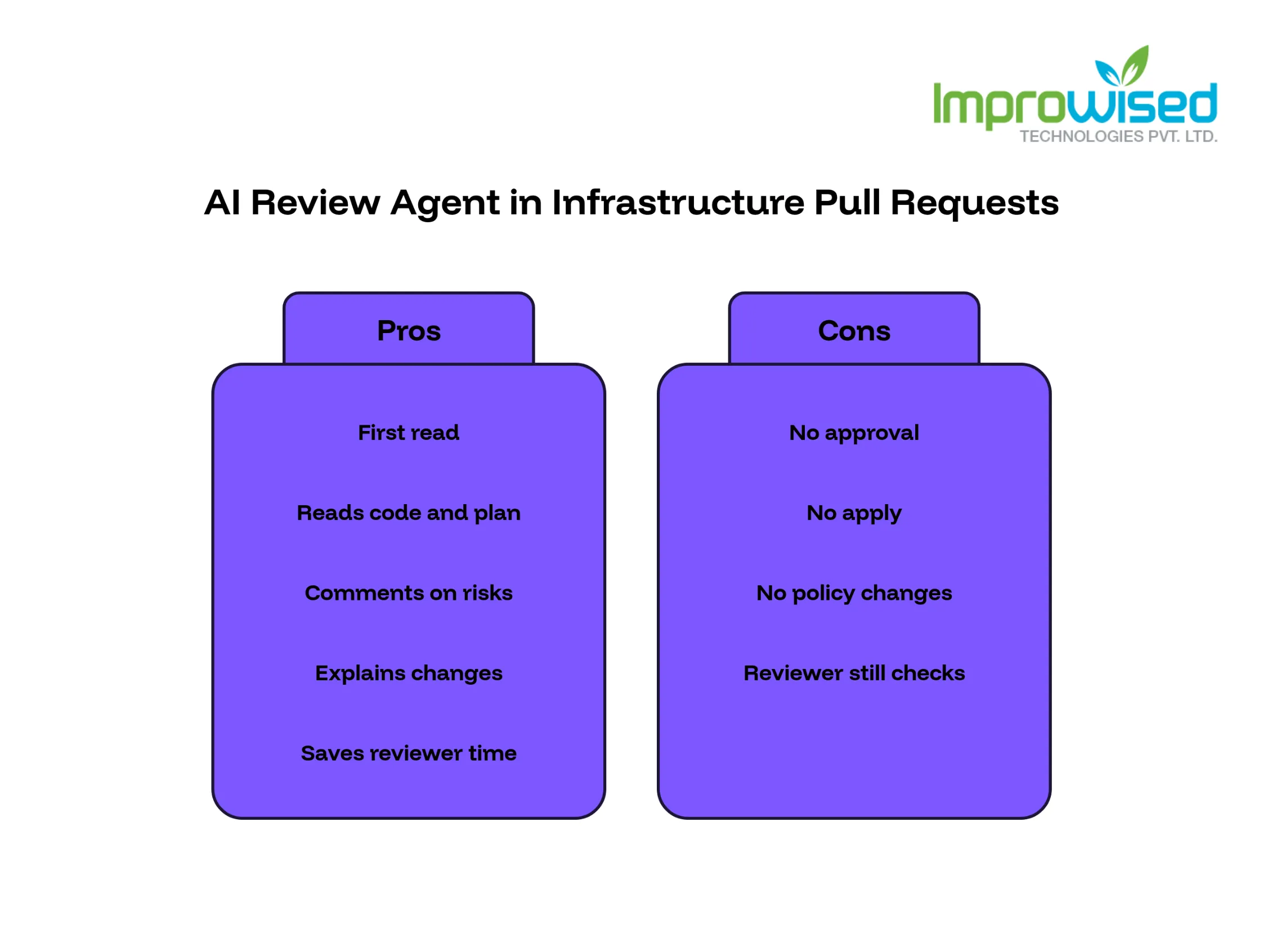
An AI agent can read the plan output of an infrastructure pull request, flag changes that look risky, and comment on the diff before a person reviews it. It does not approve the change. Fixed policy checks still decide what can merge.
This article covers what the agent reads, what it should flag, why it cannot replace policy-as-code, and how to run it on your own servers so plans and state never leave your network.
What an AI Review Agent Does in Infrastructure Pull Requests (and What It Doesn’t)
An infrastructure pull request changes real things: networks, databases, access rules, servers. Reviewing one means reading code and then working out what that code will do in your cloud account. That takes time, and it is easy to miss a line at 5 p.m. on a Friday.
The agent takes on the first read.
It does:
- Read the code diff and the plan output
- Comment on risky lines
- Explain a change in plain words, so a reviewer who doesn’t know that module can still follow it
It does not:
- Approve a pull request
- Run an apply
- Change a policy rule
In plain words: it saves the reviewer’s first pass. It does not replace the reviewer. The person still reads the comments, checks the change, and signs off.
Where the AI Review Agent Sits in Your Terraform Pipeline
The order matters. The agent runs after the plan, not before it.
- Pull request opened
- Plan generated
- Fixed policy checks run
- AI review comment posted
- Human review
- Apply
Diagram alt text: “Six-step infrastructure pipeline in order: pull request opened, plan generated, fixed policy checks, AI review comment, human review, apply.”
Why after the plan? The code shows what someone wrote. The plan shows what will actually change in your cloud. A small edit in one file can trigger a delete somewhere else, and only the plan shows that. An agent that reads only the code would miss it.
Why after the policy checks? If a fixed check already fails the pull request, the author has to fix that first. The agent’s comment then covers what the checks can’t see.
6 Risky Infrastructure Changes the Agent Should Flag
Give the agent a short, fixed list. A long, vague list produces noise.
- Public exposure: open inbound rules and publicly readable storage. One wrong rule can put a database on the internet.
- Broad permissions: wildcard access in identity policies. “Allow everything on everything” is easy to write and hard to notice later.
- Destructive changes: a replace or delete on a database, volume, or other stateful resource. Data loss starts here.
- Size and cost surprises: an instance far larger than the other resources in that environment. This is usually a typo or a copied value, and it shows up on the bill a month later.
- Missing ownership: no owner or environment tag where your team requires one. Without tags, nobody knows who to call when the resource breaks.
- Drift from module conventions: a resource written by hand where a shared module already exists. Hand-written resources skip the safe defaults your team built into the module.
Example: a plan that replaces a database
The plan shows aws_db_instance.orders must be replaced. The agent leaves this comment:
Risk: destructive change. This plan deletes and recreates the
ordersproduction database. The cause is the change to theidentifieron line 42. Replacing a database removes its data unless a snapshot is restored. Confirm a recent snapshot exists, or change the setting in place instead.
The comment names the resource, the line, the cause, and the consequence. The reviewer reads four sentences instead of 600 lines of plan output, and knows exactly what to check.
Why Policy-as-Code Keeps the Final Say on Merges
Policy-as-code means your rules are written down as checks that run on their own. Examples: “no public storage” or “every resource needs an owner tag.” They pass or fail the same way every time.
- Fixed checks give the same answer every time and leave a record. A model does not. Ask it the same question twice and the wording, or the verdict, can change.
- The agent adds context and catches odd cases. The policy check blocks the merge.
- If the agent is wrong, nothing breaks. A reviewer dismisses a bad comment. If a policy check is wrong, the pipeline stops. If your current CI/CD pipeline doesn’t have automated policy checks acting as a gatekeeper, take our free Platform Engineering Maturity Assessment to identify your operational gaps.
That difference decides who holds the final say. A check that can stop a release has to behave the same way on Monday and on Friday, and it has to show an auditor why it passed or failed. An advisor can be right most of the time and still be useful. A gatekeeper cannot.
What the AI Agent Must Never See: State Files and Secrets
Some files should never reach the agent, whatever the setup.
- State files: they can hold passwords, keys, and the full map of your resources.
- Secrets: API keys, tokens, and database credentials.
Rule: give the agent plan output with sensitive values masked. Nothing else.
Masking is a control you test, not one you assume. Run a test pull request with a fake secret in it and confirm the value never appears in what the agent receives. If masking fails, the agent should have nothing worth leaking in the first place, so also keep real credentials out of plan output wherever you can.
How to Keep AI Code Review False Alarms Low
A reviewer who sees ten wrong comments stops reading the eleventh. Track this from day one.
- Count accepted comments: the reviewer acted on it.
- Count dismissed comments: the reviewer ignored it or marked it wrong.
- Review a weekly sample of 20 comments, read by a person.
- Tune two things: the instructions you give the agent, and the rules it checks against.
If the same false alarm shows up three weeks in a row, write it into the instructions as something to ignore, or narrow the rule that triggers it.
Proof from one real repo: For concrete numbers on how we successfully tuned these AI models in a live production environment, read our case study on building a Cloud-Native AI Orchestration Platform.
Keep the dismissal number visible to the team. It is the only measure that tells you whether the agent helps or just adds noise.
Run the Agent on Your Own Servers
A plan shows your architecture: network layout, database names, account structure. That information should stay in-house.
- Plans and state stay inside your network. No third-party service receives them.
- You control what the model can read. It sees what you allow and nothing more.
- Your security team can audit it. The logs sit with the rest of your systems.
- Compliance questions get shorter. You can answer “where does this data go?” with “nowhere outside our network.”
This is exactly how we architect and run AI-assisted infrastructure reviews as part of our Platform Engineering Services. It is part of how we build secure, self-service environments, not a bolted-on product.
How to Start: One Repository, Two Weeks
- Pick one repository with frequent infrastructure changes. More changes give you more data.
- Run the agent in comment-only mode for two weeks. It comments. It never blocks anything.
- Read the dismissal rate at the end of week two.
- Decide with a rule: if reviewers dismiss more than half the comments, change the instructions and run two more weeks, or turn it off. If they act on most of them, add a second repository.
If your team wants to implement a secure, locally-hosted AI review agent without leaking infrastructure state, contact our team today to get started.
Frequently Asked Question
Get quick answers to common queries. Explore our FAQs for helpful insights and solutions.
Yes. Both tools produce a plan that lists what will be created, changed, or destroyed. The agent reads that plan and the code diff, then comments on risky lines. It works the same way for both.
No. Approval needs the same answer every time and a record of why. A model gives neither. Let it comment, and let a person and your policy checks approve.
Mask sensitive values in the plan output. Never give the agent state files. Run it on your own servers so nothing leaves your network.
Policy-as-code is a fixed rule that blocks a merge. The AI agent is a reader that explains and flags. Policy-as-code decides. The agent informs.
Track accepted and dismissed comments. A high acceptance rate means reviewers find the comments useful. A high dismissal rate means the instructions need tuning.
No. It runs after the plan, so its comment is ready by the time the reviewer opens the pull request.
Written by
Chintan Viradiya
Chintan Viradiya is a DevOps Engineer at Improwised Technologies. Passionate about Infrastructure as Code and CI/CD pipelines, he focuses on optimizing cloud deployments and enhancing the security and performance of modern applications. He plays a key role in ensuring high availability and driving DevOps best practices across projects




Optimize Your Cloud. Cut Costs. Accelerate Performance.
Struggling with slow deployments and rising cloud costs?
Our platform engineering solutions are built on open-source tools and use AI natively across the workflow.