
August 6, 2026
Your AI Isn't Broken. It's Lying Confidently, and You Don't Know It

Chandan Teekinavar
Author

Shyam Kapdi
Contributor

Shailesh Davara
Reviewer
Server crashes, database failures, and broken deployments are loud. They throw an error. Someone gets an alert. Someone fixes it.
AI does not work that way.
When a database fails, it throws an error code. When your autonomous AI agent fails, it gives your customer the wrong price, in a perfectly written sentence, with correct grammar, and total confidence. No alert fires. No dashboard turns red. Your team finds out a week later, from a customer complaint or a screenshot on social media.
This is not a technical issue for your engineering team to sort out quietly. It’s a business risk that sits on your desk.
Why This Is a CEO Problem, Not Just an Engineering Problem
Here’s the uncomfortable part: this isn’t a knowledge gap you can delegate away.
- You already trust monitoring dashboards that were never built for this. CPU usage, memory, uptime - these tools were built for infrastructure failures. They have nothing to say about a wrong answer delivered flawlessly.
- The damage shows up in places engineering doesn’t watch. Legal exposure. Customer trust. Brand reputation. Refund requests. These land on your desk, not your CTO’s ticket queue.
- “It’s working” and “it’s correct” are two different claims. Your system can be up 99.9% of the time and still be wrong 5% of the time, and nobody in the room can tell you which 5%.
- By the time you hear about it, it’s already happened to real customers. A bug report is not real-time detection. It’s a postmortem. And as we’ve noted before, traditional production incidents reveal an entirely different kind of system maturity than AI blind spots.
If you’re running a product team of any size, this gap already exists in your stack right now. The question isn’t whether it’s there. It’s whether you know about it yet.
What “Silent Failure” Actually Means (No Jargon)
Think of it like this: a junior employee who doesn’t know the answer but is too nervous to say “I don’t know”, so they guess, and they guess confidently.
That’s what an AI model does when it hallucinates. It doesn’t raise its hand. It doesn’t flag uncertainty. It just answers, and it sounds sure of itself either way.
Traditional software either works or crashes. AI has a third state: it runs perfectly while being wrong. That third state is invisible to every monitoring tool built before 2023.
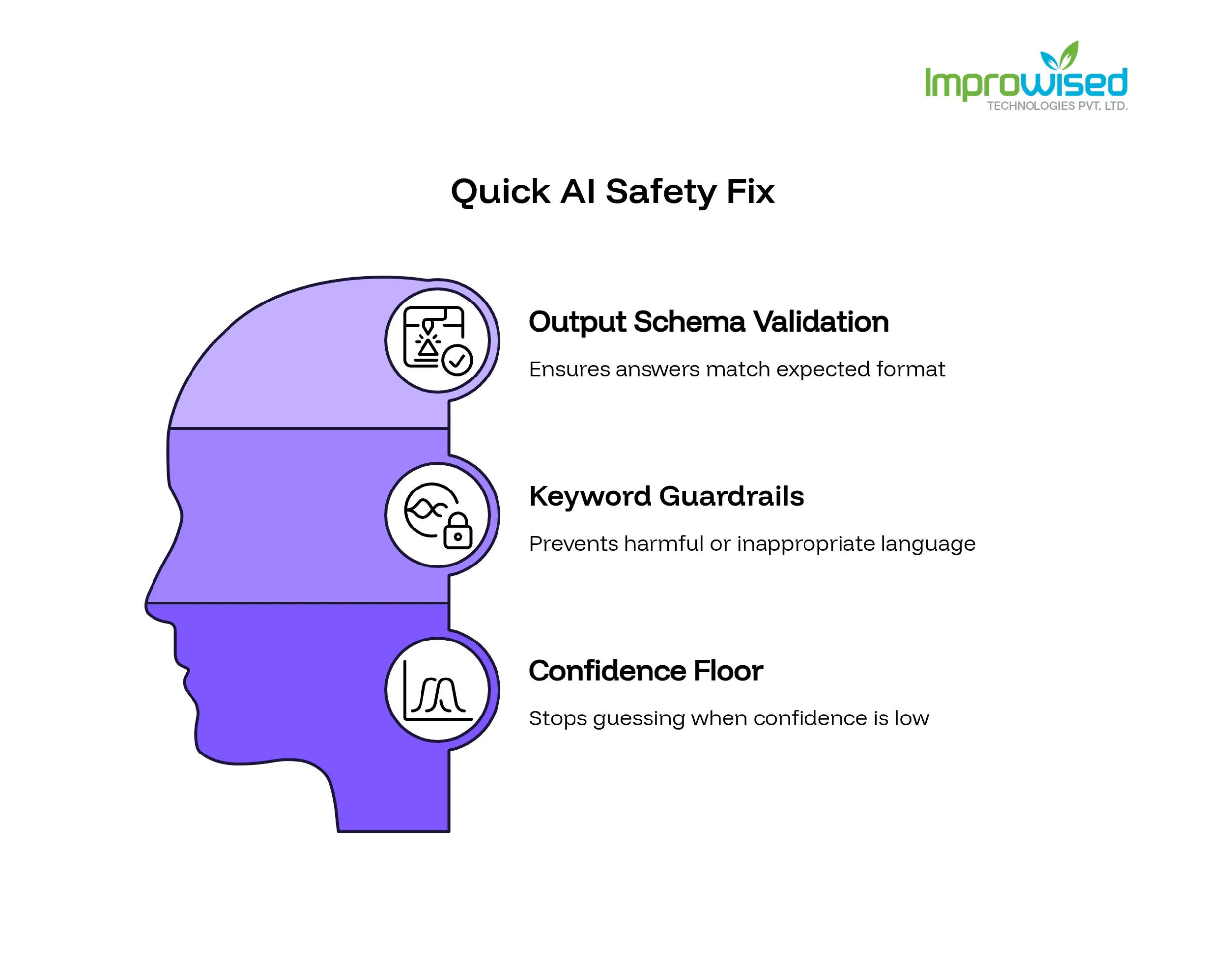
The Fix - And It’s Not a 6-Month Project
Many vendors will try to sell this as a massive replatforming effort. It isn’t one. Most engineering teams can put a real guardrail layer in place inside a single sprint. See how we implemented secure, scalable middleware in our case study for a leading AI Orchestration Platform.
Here are the three pieces:
1. Output Schema Validation
- Define exactly what a “legal” answer looks like: the type, the length, the allowed values.
- Anything outside that shape gets rejected before it ever reaches your customer.
- Think of it as a bouncer at the door checking IDs, not a security team reviewing footage after the fact.
2. Keyword Guardrails
- Keep a blocklist of phrases your AI must never say out loud, competitor names, legal disclaimers your business isn’t qualified to give, and off-limits topics.
- This check runs in milliseconds. It doesn’t slow anything down.
- It’s the difference between catching a mistake before it’s said, and apologizing for it after.
3. Confidence Floor
- When the model’s internal confidence drops below a set threshold, don’t let it guess; route it to a human or a safe fallback message instead.
- This one rule alone stops the majority of “confidently wrong” answers from ever reaching a customer.
This sits as a thin layer between your model and your front end. No fine-tuning. No new infrastructure. No six-figure vendor contract required to start. Most teams get a basic version running in one afternoon.
The 3-Rule Guardrail Stack (Save This)
If you only remember one thing from this post, screenshot this:
- ✅ Validate the shape - reject anything that doesn’t match your defined format
- ✅ Block the words - maintain a list of phrases that must never reach a user
- ✅ Trust the confidence score - when it’s low, hand off, don’t guess
Three rules. One afternoon. No excuse to still be blind next month.
One Afternoon vs. One Breach
Run the math on this yourself:
- Cost of building basic guardrails: a few engineering hours, one sprint, zero new infrastructure.
- Cost of one bad AI answer going public: a support escalation, a refund, possibly legal review, and a screenshot that outlives the apology.
- Cost of a pattern of bad answers: customer churn, a damaged reputation with your sales pipeline, and a much harder conversation with your board.
This isn’t a hypothetical. If your AI is customer-facing today and you don’t have these three checks in place, you are already running that risk; you just haven’t paid for it yet.
Run This Audit on Your Own System Right Now
Before you close this tab, ask your team one question:
“What does our AI say when it doesn’t know the answer?”
If the honest answer is “we’re not sure” or “it just answers anyway”, you have your starting point. That single question will tell you more about your real AI risk than any dashboard you’re currently looking at. If you want to uncover where else your infrastructure is carrying unmeasured risk, take our free Platform Engineering Maturity Assessment.
Where This Leaves You
You don’t need a new platform. You don’t need six months. You need three checks between your model and your customer, and about a day of engineering time to put them in place.
If you don’t know what your AI told your users today, that’s not a small gap; that’s unmeasured risk sitting inside a system your customers already trust.
We can help you stand up a basic guardrail layer this week, with no new infrastructure required. Contact us today for an Infrastructure and Architecture Review to let us look at what you already have and find out exactly where the gap is.
Frequently Asked Question
Get quick answers to common queries. Explore our FAQs for helpful insights and solutions.
A silent AI failure happens when your AI system produces a wrong or made-up answer without triggering any error, alert, or system warning. Unlike a server crash or database error, the system keeps running normally while delivering incorrect information to users.
Traditional monitoring tools track infrastructure health: CPU usage, memory, uptime, response time. They were never built to check whether an AI's answer is factually correct. An AI can be technically 'up and running' while being completely wrong, and standard tools have no way to detect that.
Most engineering teams can implement a basic guardrail layer, output schema validation, keyword blocklists, and a confidence threshold - within a single sprint, and often in one afternoon. It does not require model fine-tuning or new infrastructure.
Ask your team directly: What does our AI say when it doesn't know the answer? If nobody has a clear, confident answer, your AI is likely guessing in front of real customers right now without any safety net in place.
No. The fix sits as a middleware layer between your existing model and your front end; it doesn't require replacing, retraining, or fine-tuning your model. It's an added checkpoint, not a rebuild.
Written by
Chandan Teekinavar
Chandan Teekinavar is a DevOps Engineer at Improwised Technologies. Passionate about Infrastructure as Code and CI/CD pipelines, he focuses on optimizing cloud deployments and enhancing the security and performance of modern applications. He plays a key role in ensuring high availability and driving DevOps best practices across projects
September 18, 2026
What Platform Engineering Services Actually Include
Chintan Viradiya
Author

September 16, 2026
What Actually Slows Kubernetes Down (And What to Fix Before Adding Nodes)
Hussain Gandhi
Author

September 10, 2026
What Off-Premise Migration Actually Involves (And What It Costs)
Chandan Teekinavar
Author
Optimize Your Cloud. Cut Costs. Accelerate Performance.
Struggling with slow deployments and rising cloud costs?
Our platform engineering solutions are built on open-source tools and use AI natively across the workflow.