
June 23, 2026
CI/CD, DevOps, or Platform Engineering, Which One Does Your Team Actually Need?

Divya Kathiriya
Author

Shyam Kapdi
Contributor

Rakshit Menpara
Reviewer
If you’ve talked to three vendors in the last month, one probably called themselves a DevOps shop, another called themselves CI/CD specialists, and the third called themselves platform engineering. They might all do the same thing. Or they might not.
I’ve been on both sides of that conversation, as a buyer when I was scaling teams, and as a provider for the last 15+ years. The labels matter less than what’s actually being sold. And more importantly, what your team actually needs right now.
This is not a glossary. It’s a practical breakdown so you can walk into your next vendor call and immediately know whether they’re solving your problem or selling you something you won’t use for 2 years.
CI/CD Pipeline Setup: What It Fixes and Where It Stops
CI/CD (continuous integration and continuous delivery) is about one thing: getting code from a developer’s machine to production without it being a fire drill every time.
If your team is still deploying manually, if releases regularly break things, or if your deployment frequency is slowing down to a crawl, that’s a CI/CD problem. It’s very fixable, and fixing it makes a noticeable difference fast.
It is also a good starting point if:
-
Your engineering team is under 20 people
-
You deploy once a week or less
-
Deployment failures are your biggest day-to-day frustration
What CI/CD does not fix: it does not help when different environments behave differently. It does not sort out who has access to what. It does not reduce the number of infrastructure decisions your engineers are making. If those are your problems, you need something more.
DevOps Consulting: More Than a Pipeline, But Not a Full Platform
DevOps is not a tool. It’s not even a process. It’s a way of working where developers and operations are not running on separate tracks with a wall between them.
A DevOps engagement typically covers your CI/CD pipeline, but it also brings in monitoring, alerting, and basic cloud setup so your team is not flying blind in production. The goal is to get developers and ops working off the same process instead of blaming each other when things break.
You probably need DevOps consulting if:
-
Your developers and operations team work in silos, and releases feel like handoffs rather than a shared effort
-
You have some tooling in place, but no consistent process around it
-
Production incidents keep happening, and no one quite owns them end-to-end
Where DevOps consulting stops: your developers are still thinking about infrastructure. Every time an environment changes, every time a new service gets added, an engineer is involved in the plumbing. That slows down product work. It also means your senior engineers are doing things they should not be doing at that stage of the company.
For teams under 30 people, this is usually fine. Above that, it starts to cost you.
Platform Engineering: What It Actually Means for Your Team Day to Day
Platform engineering builds a layer between your developers and your infrastructure so developers do not have to touch infrastructure at all.
In practical terms, a developer needs a new environment. Instead of filing a ticket, waiting two days, and pulling in a senior engineer to configure it, they click a button. The environment spins up. Access is provisioned. Monitoring is on by default. The developer starts building within the hour.
That’s what a well-built internal developer platform looks like. Your product teams move faster because infrastructure is no longer a bottleneck.
Platform engineering makes sense when:
-
You have 30 to 40 or more engineers, and the infrastructure overhead is visibly slowing down delivery
-
Your senior engineers are spending 30 to 40 percent of their time on infrastructure instead of product
-
You’re planning to scale from 50 to 100 or more engineers in the next 12 to 18 months
-
You keep hiring engineers, but output does not seem to grow proportionally
I’ve seen companies wait too long on this. By the time they realize infrastructure is the bottleneck, they’ve already burned six months of senior engineering time on things a platform should have automated. That time does not come back.
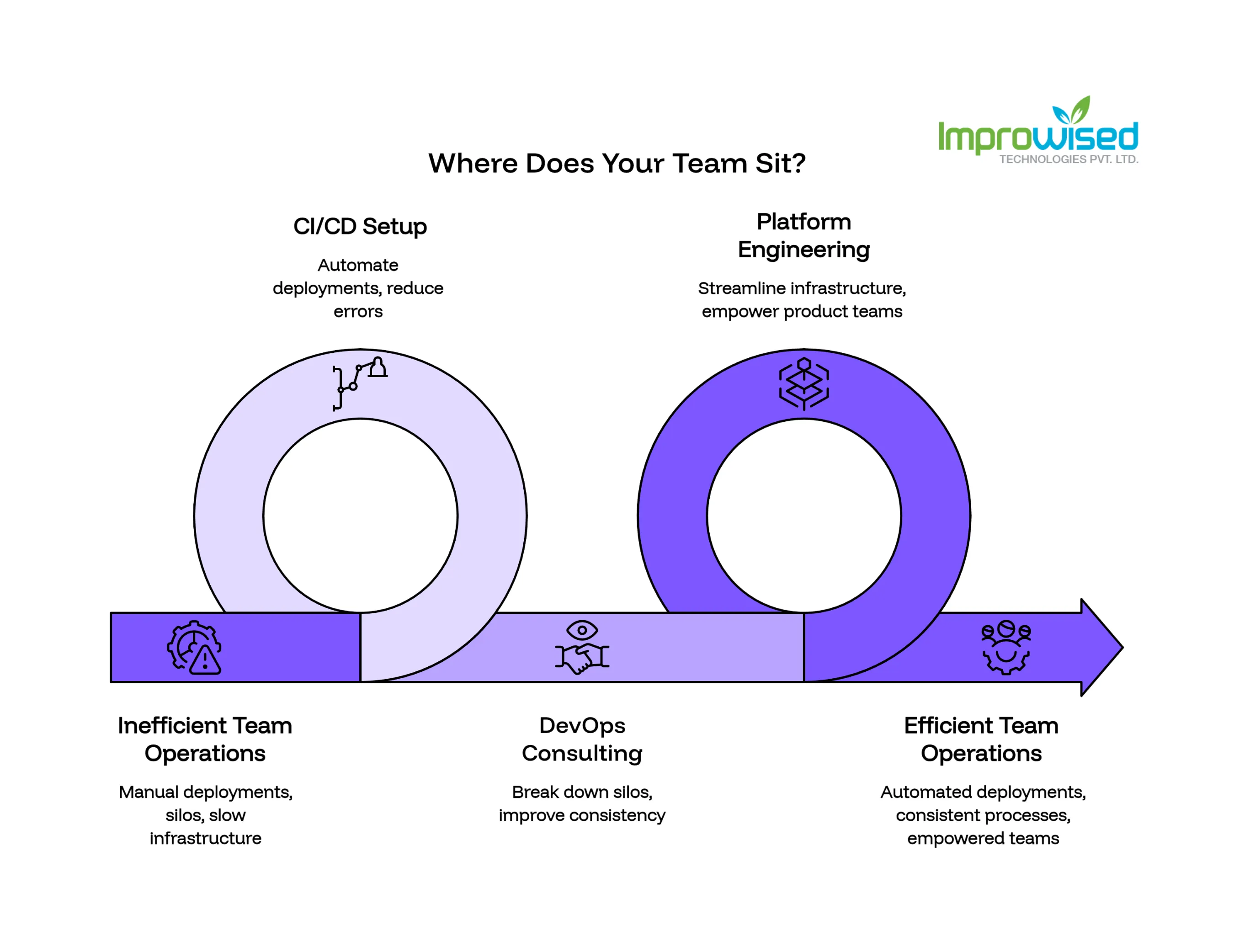
A Simple Decision Table: Where Does Your Team Sit?
Most teams fit into one of five situations. Find yours:
| Your Situation | What You Need |
|---|---|
| Deployments are manual or break often | CI/CD setup |
| Devs and ops work in silos; the process is inconsistent | DevOps consulting |
| Infrastructure work is slowing down product teams | Platform engineering |
| You’re scaling from 30 to 100+ engineers | Platform engineering |
| Senior engineers are doing infrastructure babysitting | Platform engineering |
If you’re between two of these, the answer is almost always: solve the simpler problem first. A team that cannot deploy reliably does not need a full internal developer platform yet. Get the pipeline stable, then build from there.
What Picking the Wrong One Actually Costs You
I’ll make this concrete, because I’ve seen both mistakes up close, and we’ve had to untangle them to build GitOps platforms capable of handling 7,000+ releases a year.
Teams that buy CI/CD when they need platform engineering fix the pipeline and feel good for about three to four months. Then the slowdowns come back. The pipeline works, but senior engineers are still buried in infrastructure requests. Product velocity is still stuck. They end up going back to the market six months later, spending again, and losing six months of momentum in between.
Teams that buy full platform engineering when they only need CI/CD pay for infrastructure they will not use for two years. They also often lack the engineering maturity to run it well, which means the platform sits underused and the original problem, bad deployments, still does not get fixed properly.
The right fit depends on three things:
-
Your current team size
-
How often you deploy and how painful it is
-
What’s actually eating your engineers’ time right now
Answer those honestly, and the right choice is usually obvious.
Still Not Sure Where Your Team Sits?
Most teams that come to us already have a gut feeling about what’s slowing them down. They just want an expert to look under the hood and confirm it before they spend money.
The platform readiness assessment on our site scores your team across five areas: deployment frequency, environment consistency, infrastructure ownership, developer access, and monitoring maturity in under 10 minutes. No email required to start.
Frequently Asked Question
Get quick answers to common queries. Explore our FAQs for helpful insights and solutions.
CI/CD is specifically about your code deployment pipeline, how code moves from development to production. DevOps is broader. It covers the pipeline but also brings in monitoring, cloud configuration, and the working relationship between your development and operations teams. Think of CI/CD as one part of a DevOps engagement, not a separate thing.
When infrastructure work starts visibly slowing down your product teams. A practical signal: if your senior engineers are spending more than 25 to 30 percent of their time on infrastructure requests instead of product, that's the threshold. Another signal is when you're scaling past 30 to 40 engineers, and environment setup, access management, or onboarding is becoming a recurring bottleneck.
They build an internal layer, often called an internal developer platform, that automates the infrastructure work your developers currently do manually. Spinning up environments, provisioning access, and setting up monitoring. The goal is that a developer can do these things without filing a ticket or pulling in an infrastructure engineer.
No, but it's rarely worth the investment for teams under 30 engineers. Below that size, the overhead of building and maintaining the platform often outweighs the time it saves. The sweet spot is teams between 30 and 150 engineers that are growing and where infrastructure overhead has become a measurable drag on delivery speed.
Two questions: Are your deployments unreliable or manual? If yes, start with CI/CD. Are your deployments fine, but your senior engineers still spending significant time on infrastructure requests? That's a platform engineering problem. If both are true, fix the pipeline first; a platform built on a broken deployment process doesn't help.
Written by
Divya Kathiriya
Divya Kathiriya is part of the Business Development team at Improwised Technologies. Her work places her close to cloud infrastructure and platform engineering decisions as they move from discussion to execution.Her perspective is shaped by observing recurring patterns in how platforms evolve and where teams tend to get stuck. The content she shares reflects these viewpoints, focusing on trade-offs, decision clarity, and long-term platform outcomes.


September 18, 2026
What Platform Engineering Services Actually Include
Chintan Viradiya
Author



September 16, 2026
What Actually Slows Kubernetes Down (And What to Fix Before Adding Nodes)
Hussain Gandhi
Author



September 10, 2026
What Off-Premise Migration Actually Involves (And What It Costs)
Chandan Teekinavar
Author

Optimize Your Cloud. Cut Costs. Accelerate Performance.
Struggling with slow deployments and rising cloud costs?
Our platform engineering solutions are built on open-source tools and use AI natively across the workflow.