
July 30, 2026
Kubernetes Pre-Adoption Checklist: The Operational Questions You Must Answer Before You Deploy

Chintan Viradiya
Author

Shyam Kapdi
Contributor

Shailesh Davara
Reviewer
We’ve spent over 15 years running cloud infrastructure and platform engineering teams. We’ve watched Kubernetes adoptions succeed, and I’ve watched them quietly rot for two years before anyone admits it out loud. The difference was rarely the technology. It was whether someone, before day one, wrote down who owns what.
Why Kubernetes Adoption Fails (And It’s Rarely the Technology)
Here’s the pattern I’ve seen repeat across dozens of companies:
- A team picks Kubernetes because it solves a real problem: scaling, deployment speed, infrastructure consistency.
- Everyone gets excited about what it enables.
- Nobody documents what it requires to keep running.
- Six months in, an incident happens at 2 a.m., and three teams point at each other.
Kubernetes doesn’t fail because it’s bad software. It fails because companies adopt the capability without adopting the responsibility that comes with it. That responsibility has a name: an operational model. It answers who does what, when things break, and who pays for it when nothing is breaking at all.
If your engineering team is proposing Kubernetes and cannot answer the five questions below in one page, you are not ready to approve the project, regardless of how strong the technical case is.
What Kubernetes Adoption Actually Requires Beyond the Control Plane
When people pitch Kubernetes, they usually pitch the control plane, the part that automates deployment, scaling, and recovery. That’s real. But the control plane is maybe 30% of what running Kubernetes actually demands.
The other 70% is people, process, and money:
- A team that owns the cluster itself, not just the applications running on it
- A budget line for the ongoing cost of specialized skills, tooling, and cloud spend; Kubernetes is rarely cheaper than what it replaces in year one
- An incident response chain that’s tested before it’s needed, not designed during an outage
- A decision process for upgrades, security patches, and breaking changes across every team using the cluster
- A way to measure whether the cluster is actually healthy, not just whether the apps on it appear to be working
None of this shows up in a proof-of-concept demo. All of it shows up in month eight.
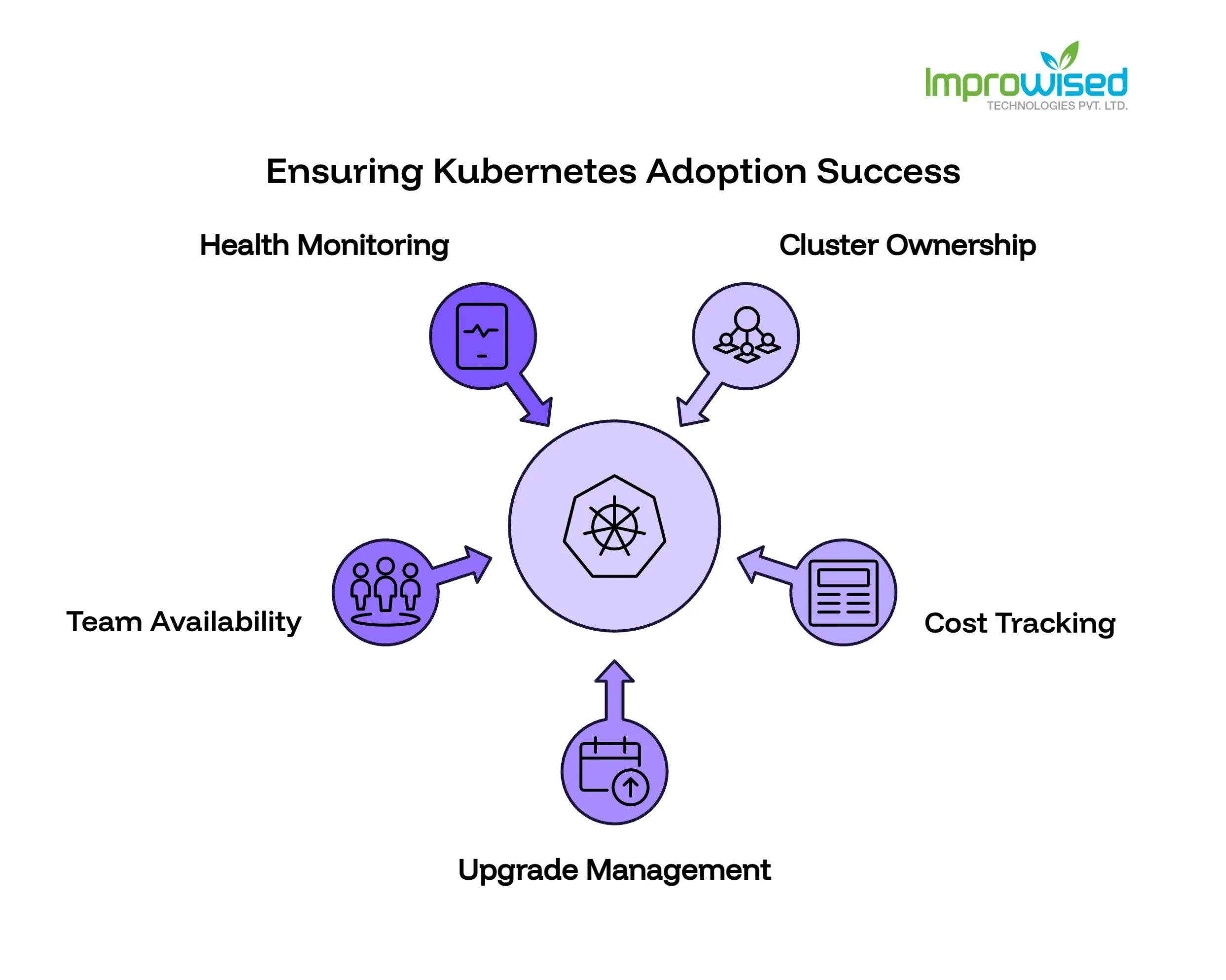
The Five Operational Questions Every Team Must Answer Before Adoption
Before you sign off on Kubernetes, ask your engineering leadership these five questions directly. If the answer to any of them is “we’ll figure that out later,” that’s your answer.
-
Who owns the cluster when something breaks at 2 a.m.? Not “the platform team” as a vague label. A named team, with a named on-call rotation, with authority to act without waiting for approval.
-
Who owns cost, and how is it tracked back to each team using the cluster? If ten teams share one cluster, someone needs to know which team’s workload is driving the bill. Without this, cost conversations turn into finger-pointing. This lack of clear resource ownership is exactly why most cloud cost reductions fail after 90 days.
-
Who approves upgrades, and how are breaking changes communicated? Kubernetes changes fast. A version upgrade that one team needs can break another team’s workload. Someone has to own that coordination, not discover it after deployment.
-
What happens when the platform team is unavailable vacation, attrition, reorg? If your entire operational model depends on two specific engineers, you don’t have an operational model. You have a dependency on two people.
-
How do you know the cluster is healthy before your customers tell you it isn’t? This means monitoring and alerting owned by a specific team, with specific thresholds, reviewed on a schedule, not dashboards nobody checks until something is already on fire.
Write the answers down. Put names next to them. If your team can’t do this in a page, that’s the actual pre-adoption work, not more technical evaluation.
Why Managed Kubernetes Doesn’t Eliminate the Operational Model Requirement
I hear this a lot from founders and non-technical executives: “We’re using a managed service, so the cloud provider handles the operations.” This is only half true, and the false half is the expensive half.
Here’s what a managed Kubernetes service, from any major cloud provider, actually takes off your plate:
- Running and patching the control plane itself
- Some baseline availability guarantees for that control plane
- Removing the need to manage the underlying cluster infrastructure by hand
Here’s what it does not take off your plate:
- Deciding who owns the applications running inside the cluster
- Managing access control across your own teams
- Responding to incidents in your own workloads
- Controlling your own cost as usage scales
- Coordinating upgrades across the teams that depend on the cluster
- Deciding what “healthy” means for your specific business
Managed Kubernetes reduces the infrastructure burden. It does not reduce the ownership burden. Companies that treat “managed” as “solved” end up with the same 2 a.m. finger-pointing problem, just with a smaller invoice from the cloud provider and the same-sized incident.
How to Design the Ownership Model for a Multi-Team Cluster
If more than one team will run workloads on the same Kubernetes cluster, ownership gets harder, not easier. Here’s a structure that has worked across the companies I’ve advised:
- One team owns the cluster as a platform. They are accountable for its health, upgrades, and security baseline. This is their full-time job, not a side responsibility. If you don’t have the headcount to staff this internally, our Platform Engineering Services can operate this layer for you.
- Each application team owns their own workloads. They are accountable for what runs inside the cluster, not the cluster itself.
- A shared escalation path exists in writing. Everyone knows who to call, in what order, for any category of incident before the incident happens.
- Cost is tagged and reviewed by the team monthly. Nobody should be surprised by their own cloud bill.
- A change advisory process exists for anything that affects every team. Cluster-wide upgrades, security patches, networking changes. One team should not be able to break another team’s production workload unilaterally. See how we structured strict cluster ownership and multi-team deployment boundaries in our Cloud-Native Managed Platform case study.
- Someone outside engineering has visibility into all of this. A CEO, COO, or CFO should be able to ask “who owns this and what does it cost us” and get a direct answer, not a shrug.
This structure doesn’t need to be complicated. It needs to be written down, agreed to, and reviewed on a schedule; quarterly is reasonable for most companies.
Signs That Your Current Kubernetes Deployment Needs an Operational Reset
If you’ve already adopted Kubernetes, here’s how to tell if you’re in trouble, even if nothing has visibly broken yet:
- Incidents get resolved by the same two or three people every time, regardless of which team’s workload caused the problem
- Nobody can tell you the monthly cost breakdown by team without a multi-day exercise
- Upgrades get delayed for months because nobody wants to own the risk of breaking something
- New teams onboard onto the cluster without any documented process, just informal help from whoever’s available
- Your engineering leadership uses the word “eventually” when you ask who owns cluster health
- Postmortems consistently list “unclear ownership” or “coordination gap” as a contributing factor, and nothing changes afterward
If two or more of these are true, you don’t need a new tool. Find out exactly where your operational gaps lie by taking our free Platform Engineering Maturity Assessment. You need to pause new feature work on the cluster and rebuild the operational model ownership, cost tracking, incident response, and change management before you add another team or workload to it.
Conclusion
Kubernetes is infrastructure. Infrastructure needs owners, budgets, and a plan for the day something breaks. That’s not a technical decision; it’s a business decision, and it belongs on your desk before the deployment starts, not after the first outage forces the conversation.
The technology will do what it’s designed to do. Whether your organization can run it depends entirely on the decisions you make before deployment. Contact our team today to build a resilient Kubernetes operational model before your next outage forces the conversation.
Frequently Asked Question
Get quick answers to common queries. Explore our FAQs for helpful insights and solutions.
A Kubernetes operational model is the documented set of decisions covering who owns the cluster, who responds to incidents, how costs are tracked by team, and how upgrades and changes are approved. It's separate from the technical setup and must be defined before adoption, not after.
No. Managed Kubernetes services from cloud providers handle the control plane and some infrastructure maintenance, but your company is still responsible for workload ownership, incident response, cost control, and cross-team coordination.
A dedicated platform team should own the cluster itself, its health, security, and upgrades, while individual application teams own the workloads they run on it. This split needs to be documented and agreed to before multiple teams share one cluster.
Most failures come from unclear ownership, undocumented incident response processes, untracked cost across teams, and uncoordinated upgrades, not from the technology itself. Technical problems are usually a symptom of an unclear operational model.
If your engineering leadership can answer, in writing, who owns the cluster, who owns cost, who approves upgrades, what happens if key staff leave, and how cluster health is monitored, you're ready. If any of these are unanswered, that work needs to happen first.
Written by
Chintan Viradiya
Chintan Viradiya is a DevOps Engineer at Improwised Technologies. Passionate about Infrastructure as Code and CI/CD pipelines, he focuses on optimizing cloud deployments and enhancing the security and performance of modern applications. He plays a key role in ensuring high availability and driving DevOps best practices across projects


September 18, 2026
What Platform Engineering Services Actually Include
Chintan Viradiya
Author


September 16, 2026
What Actually Slows Kubernetes Down (And What to Fix Before Adding Nodes)
Hussain Gandhi
Author



September 10, 2026
What Off-Premise Migration Actually Involves (And What It Costs)
Chandan Teekinavar
Author

Optimize Your Cloud. Cut Costs. Accelerate Performance.
Struggling with slow deployments and rising cloud costs?
Our platform engineering solutions are built on open-source tools and use AI natively across the workflow.