
September 10, 2026
What Off-Premise Migration Actually Involves (And What It Costs)

Chandan Teekinavar
Author

Shyam Kapdi
Contributor

Shailesh Davara
Reviewer
In infrastructure and platform engineering work, CEOs, CTOs, and IT heads all use the phrase “off-premise migration”, and rarely mean the same thing by it. Some mean moving everything to the cloud. Some mean moving half of it. This post is not a sales pitch. It’s the order of operations, the real cost range, and the parts that go wrong, so you know what you’re signing up for before you commit budget or headcount to it.
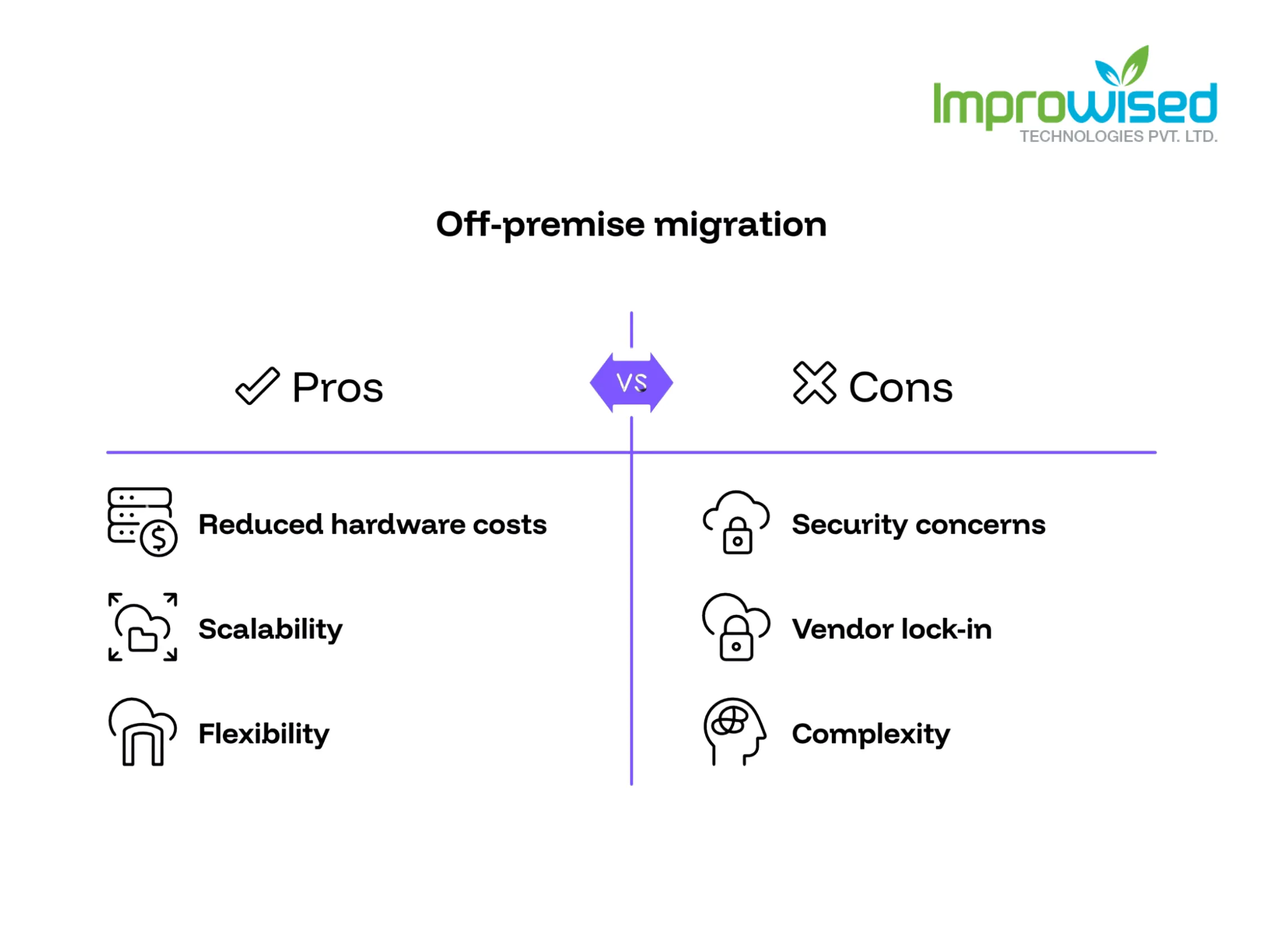
What “off-premise” usually means in practice
This term gets used loosely, and that looseness costs teams money later. Before any planning starts, get specific about which one you’re actually doing:
- Full cloud migration — everything moves off your own data centers and onto a cloud provider. No physical hardware left to maintain.
- Hybrid migration — some workloads move off-premises, some stay on your own infrastructure, permanently or for a defined period.
- Lift-and-shift — you move applications as-is, without redesigning them, just to get off physical hardware fast.
- Re-architected migration — you rebuild applications to actually work well in a cloud environment, not just survive there.
Most companies think they want the first option and end up needing the second. That’s not a failure; it’s just what the data and the applications usually demand once you look closely.
The order migrations usually happen in
Migrations that go badly usually skip one of these steps or do them out of order. Here’s the map, not the full guide:
- Initial assessment — inventory what you actually have: applications, dependencies, data volumes, compliance obligations. Most companies underestimate this list by a wide margin. A great first step to measure your team’s operational readiness for this move is our free Platform Engineering Maturity Assessment.
- Migrate non-critical workloads first — start with systems that won’t take down the business if something goes wrong. This is where you learn what your real migration speed and cost look like.
- Data migration planning — figure out what data moves, in what order, and how you keep it in sync during the transition. This is usually the slowest part, not the applications.
- Cutover — the point where production traffic actually switches over. This should be the least dramatic step if the first three were done properly.
If cutover feels dramatic, something upstream was rushed.
What gets harder than expected
Nearly every migration hits at least one of these. Plan for them; don’t discover them mid-project:
- Data gravity — large datasets are expensive and slow to move. The bigger the dataset, the more the cost and time estimates from step one start to look optimistic.
- Legacy dependencies nobody documented — old systems that quietly connect to five other things nobody remembers. These surface during migration, not before it.
- Compliance tied to physical location — some data legally has to stay in a specific location or jurisdiction. This isn’t a technical constraint you can engineer around; it’s a legal one that shapes the whole plan.
None of these are reasons to avoid migration. They’re reasons to budget time and money for discovery before you commit to a date.
A realistic cost and timeline range
For a mid-size infrastructure setup (think a few hundred servers, a mix of applications built over 5–10 years, moderate compliance requirements), here’s a typical range, not a quote, and not a promise:
- Timeline: 6 to 18 months, depending on how much re-architecture is needed versus straight lift-and-shift.
- Cost: Commonly falls between $250,000 and $2 million+, driven mostly by data volume, the number of legacy dependencies, and how much of the application layer needs rebuilding rather than just relocating. If you do a pure lift-and-shift without rebuilding, you will quickly discover why cloud cost reductions fail after 90 days.
- The variable that moves the number most: how much was actually documented before you started. Undocumented systems add cost every time, not sometimes.
If a vendor gives you a fixed number before doing an assessment, that number is a guess wearing a suit.
What to audit before you start
Before committing to any migration plan, these need answers, in writing, not in someone’s head:
- Full inventory of applications and their dependencies
- Data classification: what’s sensitive, what’s regulated, what’s just large
- Current infrastructure capacity and utilization: what’s actually being used versus provisioned
- Existing compliance and data residency obligations
- Realistic in-house bandwidth to run this alongside normal operations
This is exactly what our Infrastructure and Architecture Review Service is built to answer before a migration date gets set: a cost and risk read before the decision, not after.
Hybrid as a real end state, not just a transition phase
There’s an assumption that hybrid is a waiting room, something you pass through on the way to full cloud. For a lot of companies, that’s wrong.
Hybrid can be the correct permanent setup when:
- Certain workloads perform better or cheaper on dedicated hardware
- Compliance requires specific data to stay in a specific location, indefinitely
- Some legacy systems aren’t worth re-architecting, but aren’t worth killing either
- Cost modeling shows a mixed setup outperforms full cloud at your specific scale
If your team keeps treating hybrid as temporary, you’ll keep delaying decisions that should be made now. Some companies run hybrid for years because it’s the right fit, not because they haven’t finished migrating. See how we engineered a permanent, high-performance distributed architecture in our Multi-Cloud Hosted Data Lake Case Study.
Before you set a migration date, get a cost and risk read on what you’re actually working with. An Infrastructure & Architecture Review gives you that picture before the decision is made, not after the budget is spent. Contact us today to schedule your review and read on your migration roadmap.
Frequently Asked Question
Get quick answers to common queries. Explore our FAQs for helpful insights and solutions.
It refers to moving applications, data, or infrastructure off a company's own physical hardware. It can mean full cloud migration, hybrid migration, or a mix; the specific meaning changes based on what the team actually needs, not what the term implies.
For a mid-size setup, costs commonly range from $250,000 to $2 million or more, depending on data volume, the number of undocumented legacy dependencies, and how much re-architecture is required versus a straight lift-and-shift.
Most mid-size migrations take 6 to 18 months. The timeline is driven mainly by data volume and how much of the application layer needs to be rebuilt rather than simply relocated.
For many companies, hybrid is the correct long-term setup, not a stepping stone. Compliance requirements, cost performance at specific scale, and legacy systems that aren't worth rebuilding can all make hybrid the right permanent choice.
Undocumented legacy dependencies, underestimated data volume, and compliance requirements discovered mid-project are the most common causes. Most of these get missed because the initial assessment wasn't thorough enough before the plan was set.
A full inventory of applications and dependencies, data classification, current infrastructure utilization, compliance obligations tied to data location, and an honest read of in-house bandwidth to run the migration without disrupting normal operations.
Written by
Chandan Teekinavar
Chandan Teekinavar is a DevOps Engineer at Improwised Technologies. Passionate about Infrastructure as Code and CI/CD pipelines, he focuses on optimizing cloud deployments and enhancing the security and performance of modern applications. He plays a key role in ensuring high availability and driving DevOps best practices across projects


September 7, 2026
What Uptime Assurance Actually Covers And What It Doesn't
Chintan Viradiya
Author



September 1, 2026
What FluxCD Actually Does, and When to Use It Instead of Jenkins
Hussain Gandhi
Author

August 27, 2026
Jira to Asana Migration: A Practical Checklist for Engineering Teams
Brij Mandaliya
Author

Optimize Your Cloud. Cut Costs. Accelerate Performance.
Struggling with slow deployments and rising cloud costs?
Our platform engineering solutions are built on open-source tools and use AI natively across the workflow.