August 13, 2026
The Cognitive Load Tax: How Over-Tooled Engineering Environments Slow Down Smart Teams

Shyam Kapdi
Author

Divya Kathiriya
Contributor

Shailesh Davara
Reviewer
In most board meetings, someone shows a slide with “50+ engineering tools,” and the room nods like it proves the company is sophisticated.
It doesn’t. It usually proves the opposite.
Every tool added to an engineering stack has a price tag beyond the invoice. That price is paid in attention, in switching time, and in decisions engineers make every single day about which system to open, which login to remember, and which dashboard has the answer. Most leadership teams never see this cost because it doesn’t show up on a single line item. It shows up as “engineering feels slower than it should,” and nobody can point to why.
This breaks down that “why.”
What Cognitive Load Actually Costs Your Company
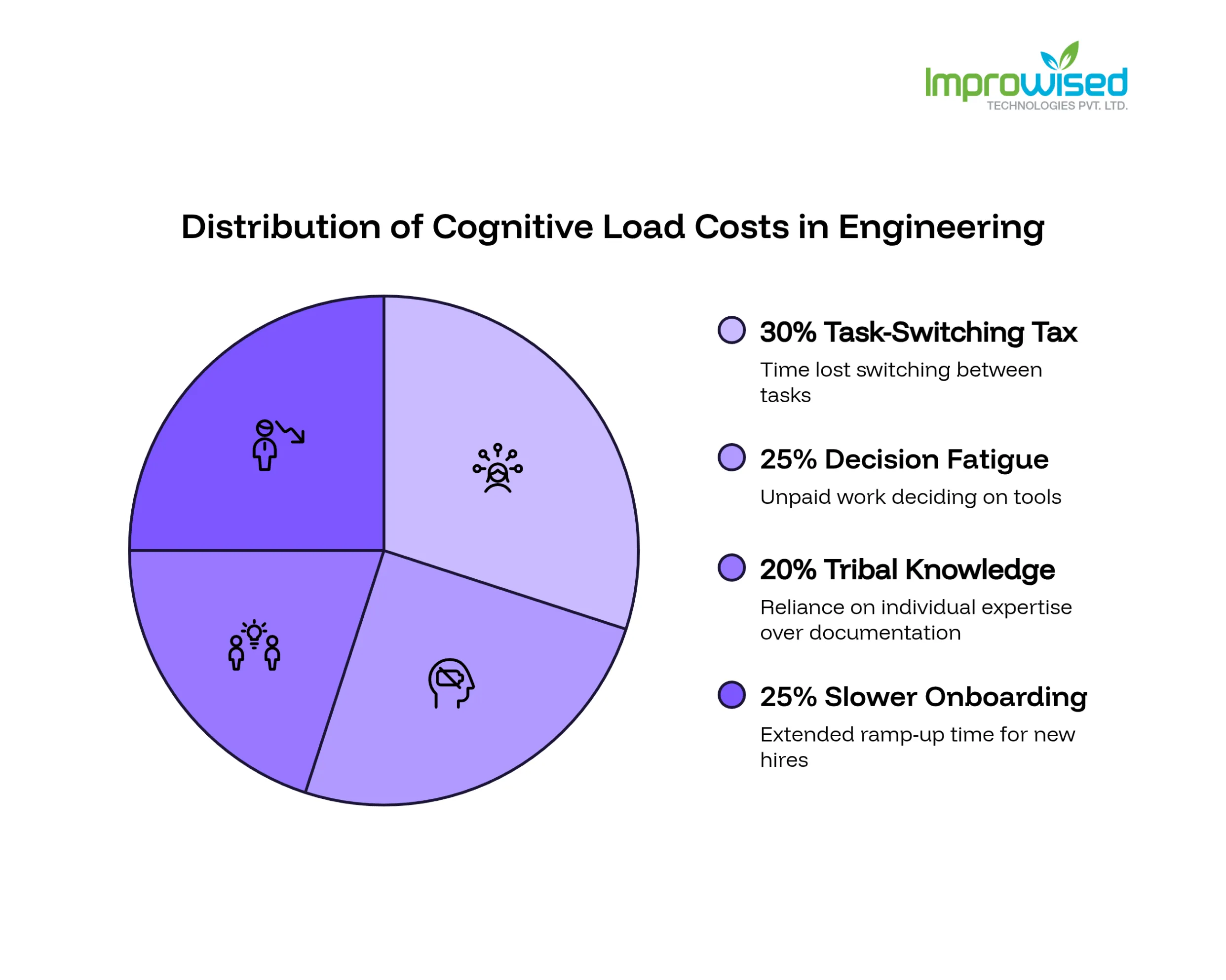
Cognitive load is not a soft, feel-good HR term. It is a real, measurable drag on output. Here’s what it looks like on the ground:
- Task-switching tax: Every time an engineer moves from writing code to checking a monitoring tool, then to a ticketing system, then to a deployment dashboard, their brain has to reload context. Research on task switching consistently shows this costs real time, not seconds, but minutes per switch.
- Decision fatigue before the real work starts: Before an engineer fixes a bug, they first decide which of six tools tells them what’s actually broken. That decision itself is unpaid work.
- Tribal knowledge instead of documented process: When tools multiply, “how we do things” stops living in documentation and starts living in a few senior engineers’ heads. That’s a business risk, not a productivity feature.
- Slower onboarding, permanently: New hires don’t ramp up on your product. They ramp up on your tool stack first. The bigger the stack, the longer the ramp, and it never gets cheaper.
None of this shows up in a productivity report. It shows up as missed deadlines, ballooning headcount requests, and engineers who look busy but ship less than they used to.
How Tool Sprawl Builds Without Anyone Approving It
No one in your company ever sat down and decided, “Let’s make this complicated.” It happens in small, individually reasonable steps:
- A team adopts a new tool to solve one specific problem. Nobody asks what already exists that could solve it.
- A vendor offers a free tier or a pilot. It gets adopted quietly, without procurement or leadership visibility.
- A reorg merges two teams with two different tool stacks. Instead of picking one, both survive “for now.”
- An acquisition brings in an entirely separate platform. Integration gets deprioritized because the immediate business goal was the deal, not the tooling.
- Nobody owns tool retirement. Adding a tool has an owner and a budget line. Removing one does not. So tools just accumulate, like sediment.
By the time leadership notices, the company isn’t running one platform. It’s running a patchwork of six or seven partial platforms, stitched together by scripts and institutional memory. This accumulation is exactly what creates delivery path sprawl and hidden CI/CD costs.
Why “Best-of-Breed” Quietly Becomes a Liability
“Best-of-breed” sounds like good judgment. Pick the top tool for each job, the best CI/CD tool, the best monitoring tool, the best incident management tool, and combine them. On paper, this looks like discipline.
In practice, here’s what it produces:
- Integration becomes its own full-time job. Someone has to keep the connections between these “best” tools working. That someone is your engineering time, not a vendor’s.
- Nobody owns the seams. Each tool has an owner. The gaps between tools do not. When something breaks at the boundary, the finger-pointing starts.
- Upgrades break things you didn’t touch. Tool A updates its API. Tool B’s integration silently fails. Nobody notices until production is affected.
- Your team becomes tool experts instead of product experts. The skill that gets valuable inside your company is “knowing how our six tools talk to each other,” a skill with zero value anywhere else, including your own company after a platform change.
The individual tools might genuinely be the best in their category. The system they form together is often worse than a single, average platform that does five things adequately and keeps them connected. This is why our Platform Engineering Services focus on building cohesive, self-service developer platforms rather than just chaining top-tier tools together.
How to Audit Your Platform’s Cognitive Load in One Day
You don’t need a six-month consulting engagement to see this clearly. You need one day and honest answers. For a faster, data-driven look at your tool stack, take our 5-minute Platform Engineering Maturity Assessment to measure your current cognitive load against industry benchmarks.
Morning: Map the real toolchain
- List every tool a typical engineer touches to ship one feature, start to finish, not the tools that exist, the tools actually used.
- For each tool, write down who owns it, who pays for it, and when it was last reviewed.
- Circle any tool with no clear owner. That’s your first red flag list.
Midday: Shadow one engineer
- Sit with one mid-level engineer for half a day. Literally watch them work.
- Count every login, every dashboard switch, every “let me check the other tool” moment.
- Ask them, unscripted: “What’s the most annoying part of your day that has nothing to do with the actual problem you’re solving?”
Afternoon: Score for overlap and gaps
- Identify tools that do the same job for different teams.
- Identify handoff points where information has to be manually copied from one tool to another.
- Rank tools by how many people depend on them daily versus how many people maintain the connections keeping them alive.
End of day: One page, three columns
- Column one: tools that are load-bearing and clearly owned.
- Column two: tools that overlap or duplicate functions.
- Column three: tools nobody can explain why the company still pays for.
If column three is longer than column one, you have your answer.
What a Low-Cognitive-Load Platform Actually Looks Like
This isn’t about having fewer tools for their own sake. It’s about having a platform where the number of tools matches the number of real, distinct decisions your engineers need to make.
- One place to find the state of any system. Not five dashboards that might have the answer, but one place engineers go by default.
- Fewer handoffs, not fewer capabilities. The goal isn’t cutting functionality. It’s cutting the manual steps between functions.
- Clear ownership for every tool, including its removal. Every tool on the roster has a named owner and a scheduled review date, the same way you’d review a vendor contract.
- New hires productive in days, not months. If onboarding takes six weeks because of tooling alone, that’s not a training problem; that’s a platform design problem. See how we reduced cognitive load and enabled 7,000+ seamless releases a year in our GitOps Transformation Case Study.
- Engineers can describe their workflow in one sentence. If it takes a diagram to explain how a ticket moves from report to resolution, your platform is doing the opposite of its job.
The companies that move fastest at scale usually aren’t the ones with the most sophisticated tool stack. They’re the ones where an engineer can sit down, open one or two systems, and immediately know where the problem is and what to do about it.
That’s not a technology decision. That’s a leadership decision, and it belongs at the top of the organization, because nobody below that level has the authority to tell four different teams to give up their favorite tool for the good of the whole company. Contact us today to start that leadership conversation and consolidate your stack into a platform that actually accelerates engineering.
Frequently Asked Question
Get quick answers to common queries. Explore our FAQs for helpful insights and solutions.
Cognitive load is the mental effort an engineer spends managing tools, remembering logins, and switching context, effort that isn't spent solving the actual technical problem. It's a hidden cost that doesn't appear on any invoice but shows up as slower output.
If a new engineer needs more than a week to know which tool to open for a given task, or if your senior engineers are the only ones who understand how systems connect, you likely have tool sprawl. A one-day audit mapping tools, shadowing an engineer, and checking for overlap will confirm it quickly.
No, but it comes with a hidden integration cost that companies rarely budget for. Best-of-breed makes sense when you have a dedicated team to maintain the connections between tools. Without that, it often produces more overhead than the individual 'best' tools save.
Individual teams can flag the problem, but only leadership can approve consolidation, because it usually requires teams to give up a tool they personally prefer. This is a cross-functional, budget-level decision, not a technical one.
Start with the one-day audit: list every tool actually used, assign ownership, and identify overlaps. You don't need a full platform overhaul on day one; you need visibility into where the overhead is actually coming from.


August 18, 2026
AI Agents Talking to Each Other?
Hussain Gandhi
Author



August 6, 2026
Your AI Isn't Broken. It's Lying Confidently, and You Don't Know It
Chandan Teekinavar
Author

July 30, 2026
Kubernetes Pre-Adoption Checklist: The Operational Questions You Must Answer Before You Deploy
Chintan Viradiya
Author

Optimize Your Cloud. Cut Costs. Accelerate Performance.
Struggling with slow deployments and rising cloud costs?
Our platform engineering solutions are built on open-source tools and use AI natively across the workflow.