
October 6, 2026
What a DevOps Consulting Partner Should Deliver in the First 90 Days

Chandan Teekinavar
Author

Shyam Kapdi
Contributor

Shailesh Davara
Reviewer
We hear the same line from most vendors: “We’ll set up your pipeline.” It sounds clear, but it isn’t. It doesn’t say what you get, who builds it, or when it goes live. This post gives you the timeline we work to: what should happen in days 1-30, 31-60, and 61-90, which warning signs to watch for, and what to get in writing before you sign.
Why “We’ll Set Up Your Pipeline” Isn’t a Real Scope of Work
A pipeline can mean a single build script or a full release process across ten teams. When the scope is that loose, both sides read it differently, and the gap shows up in month three. This is exactly how companies end up with the bloated pipelines we covered in Delivery Path Sprawl Is the Hidden Cost of Your CI/CD.
Vague scope is the most common reason DevOps engagements underdeliver. Not bad engineers. Not bad tools. Nobody agreed on what “done” means.
If you’re still comparing vendors, our list of the top DevOps consulting companies is a good place to start. Once you have a shortlist, use the timeline below to test each one.
DevOps Consulting Days 1-30: Audit, Quick Wins, No Big Rewrites
The first month is for learning your setup and fixing small things. Here is what you should see:
- A written audit of your current state. How code gets from a developer’s laptop to production, where it slows down, and where it breaks.
- A list of risks. Missing backups, shared passwords, servers nobody owns, deploys that only one person can run.
- Quick wins, some already shipped. Examples: a flaky test fixed, a manual step automated, a cloud bill line item cut.
- A ranked plan. What gets done first, what waits, and why.
- Access and working agreements. Who approves changes, who is on call, how you’ll communicate.
Red flag at this stage: a proposal to rebuild everything. Nobody knows enough about your systems in 30 days to justify that. Big rewrites come after evidence, not before it. Which is why our engagements always start with a dedicated Infrastructure and Architecture Review.
Days 31-60: The First Pipeline or Infrastructure Change Goes Live
By day 31, the work moves from paper to production. By day 60, at least one real change should be running in your live environment. Not in a test account. Not in a slide deck.
What that looks like:
- One working pipeline for one real service, so your developers are already using it.
- Or one infrastructure change in production, such as servers defined in code, a monitored database, or a safer deploy process.
- Written steps for how it works and how to undo it if something goes wrong.
- A short review of what improved: faster releases, fewer failed deploys, less manual work. Numbers, not opinions. For example, see how we dropped manual interventions and scaled to 7,000+ deployments in our GitOps Transformation Case Study.
If day 60 arrives and you have a 40-page plan but nothing running, the engagement is behind.
Days 61-90: Knowledge Transfer and What “Done” Should Look Like
The last 30 days are about making the consultant less necessary. You should see:
- Your engineers making changes themselves. They add a new service to the pipeline or edit the infrastructure setup with the consultant reviewing, not driving.
- Documentation your team actually uses. Plain steps, not a pile of screenshots.
- A runbook for common problems. What to check first when a deploy fails or an alert fires.
- A walkthrough session for the whole team, recorded.
- A clear next-steps list. What remains, what it costs, and what you can do in-house.
The test for “done”: if your team can extend the work on a normal Tuesday without calling the consultant, the handoff worked. If every change still needs them, it didn’t.
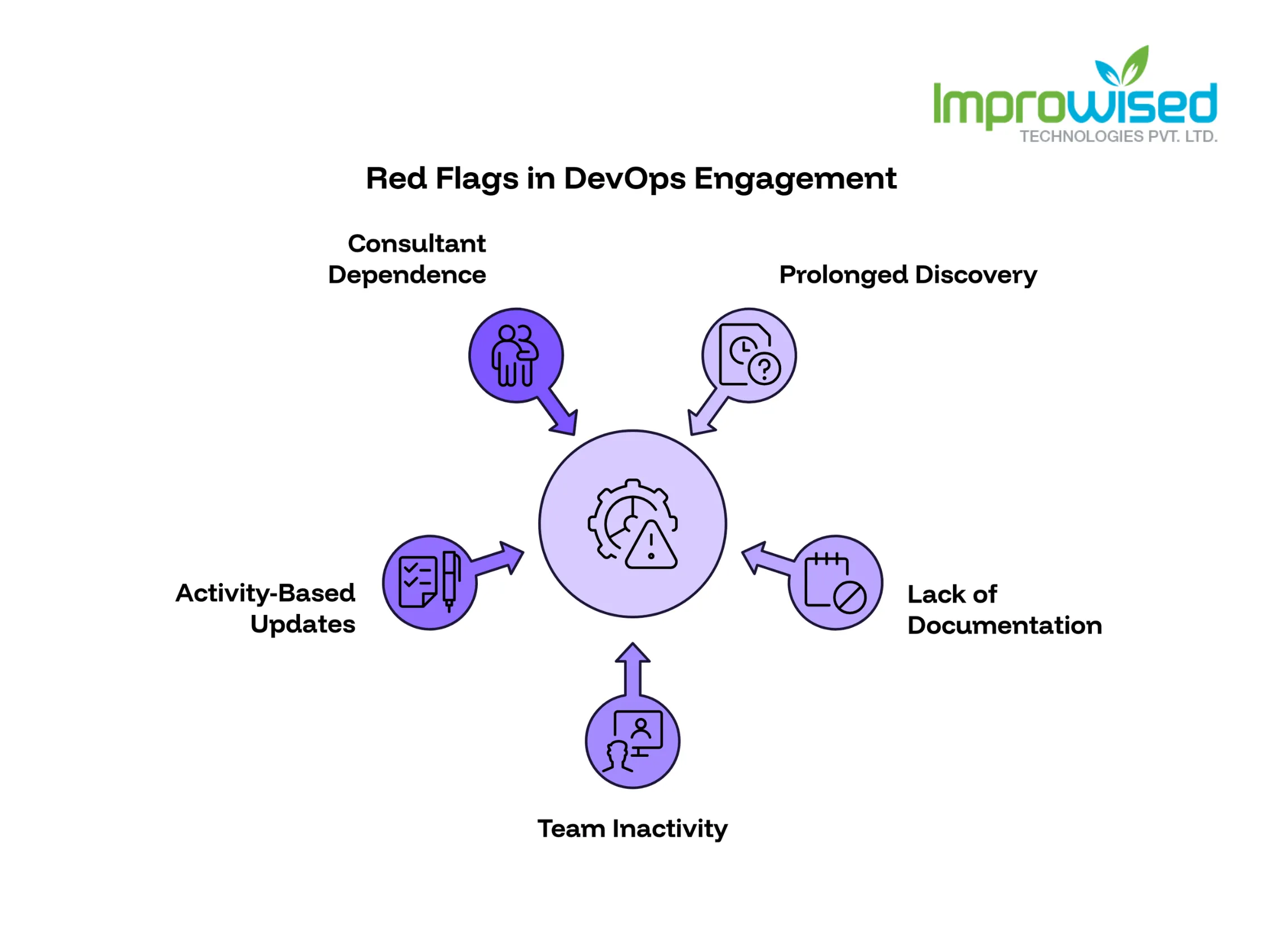
5 Red Flags Your DevOps Engagement Is Going Nowhere
Check these at day 30, 60, and 90:
- Still in “discovery” after day 30. Discovery should end with a written audit and a plan, not run indefinitely.
- No documentation is being produced. If knowledge lives only in the consultant’s head, you’re renting it.
- Your team hasn’t touched the new setup. If your engineers have only watched, they can’t maintain it.
- Status updates describe activity, not results. “We held 12 meetings” is not progress. “Deploy time dropped from 3 hours to 40 minutes” is. If you want a data-driven read on your team’s actual performance baseline, take our free Platform Engineering Maturity Assessment.
- Every fix needs the consultant. That’s dependence, not delivery.
What to Get in Writing Before You Sign a DevOps Contract
Ask for these in the statement of work:
- Deliverables for each phase. Specific outputs for days 1-30, 31-60, and 61-90.
- A named point of contact. One person, not “the team.”
- Your team’s involvement. Which of your engineers work with the consultant, and how many hours per week do they work?
- A definition of “handoff.” For example: your team deploys a change alone, using the documentation, without help.
- Production proof. What must be live, and in which environment, by day 60.
- Ownership of everything built. Code, scripts, and documents belong to you.
- An exit clause. What happens if milestones are missed.
If a vendor resists putting any of this on paper, treat that as an answer.
Ready to See What Your First 90 Days Would Look Like?
Tell us your current setup, and we’ll outline what a realistic plan looks like for you specifically. Contact us to talk to our team
Frequently Asked Question
Get quick answers to common queries. Explore our FAQs for helpful insights and solutions.
A written audit of your current setup, a list of risks, a ranked plan, and a few quick wins. They should not propose a full rewrite yet.
Many initial engagements run 90 days. That is enough to audit, ship a first change, and hand over knowledge. Larger migrations take longer, but they should still be split into 90-day phases with their own deliverables.
A contract document listing what the consultant will deliver, by when, who is responsible, and how handoff is defined. Without one, scope tends to drift.
Common signs: still in discovery past day 30, nothing live in production by day 60, no documentation, and your team hasn't worked in the new setup.
It means your internal team can run and extend the work without the consultant. Write the test into the contract, such as your engineers ship a change independently using the documentation.
Written by
Chandan Teekinavar
Chandan Teekinavar is a DevOps Engineer at Improwised Technologies. Passionate about Infrastructure as Code and CI/CD pipelines, he focuses on optimizing cloud deployments and enhancing the security and performance of modern applications. He plays a key role in ensuring high availability and driving DevOps best practices across projects








Optimize Your Cloud. Cut Costs. Accelerate Performance.
Struggling with slow deployments and rising cloud costs?
Our platform engineering solutions are built on open-source tools and use AI natively across the workflow.